ARTE
BELEZA E BEM-ESTAR
ARTESANATO
CULTURA E HISTÓRIA
ENTRETENIMENTO
MEIO AMBIENTE
COMIDA E BEBIDAS
ENGENHARIA REVERSA
CIÊNCIAS
ESPORTES
TECNOLOGIA
TECNOLOGIA VESTÍVEL
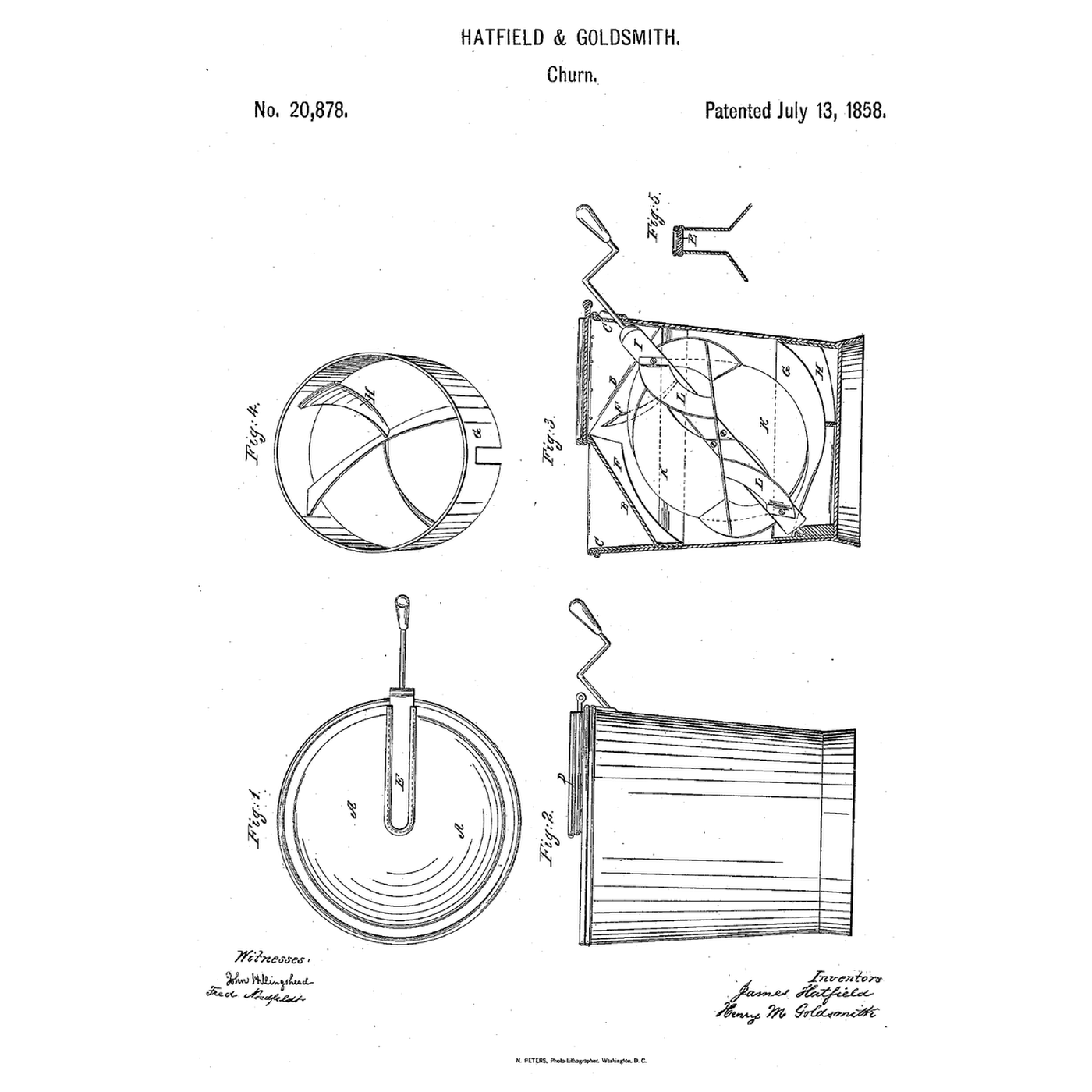


Oblique-Shaft Basin-Lid Churn: A Slanting Agitator Between Brakes, a Lid That Holds Tempering Water
James Hatfield of Falmouth, Indiana, and Henry M. Goldsmith of Burlington, Iowa, received US 20,878, dated 13 July 1858, for a churn with a triangular agitator shaft slanting across the vessel, wings set across it at 45 degrees, brakes above and below, and a lid sunk into a basin of hot or cold water, with a glass slide to watch.
This rung prints the shaft, agitator, brakes and basin lid at tabletop scale, on a stock pot.
Avançado
About 6 hours, plus printing
Instruções
1
1
The slant and the wings
The slant and the wings
A carregar o notebook Jupyter…
2
2
Slanting dasher shafts, before it
Slanting dasher shafts, before it
That shaft carried dished blades; this one a disk across it at 45 degrees, braced by quarter-circle wings.
3
3
Read US 20,878
Read US 20,878
"The basin or reservoir lid is so arranged as to contain either hot or cold water which being circulated through the cream by the action of the agitator and brakes soon reduces the cream to the desired temperature."
4
4
Print the parts
Print the parts
Print the shaft (/uploads/blueprints/oblique-shaft-basin-lid-churn-shaft.stl) lying on a flat face across the bed's diagonal, the agitator (/uploads/blueprints/oblique-shaft-basin-lid-churn-agitator.stl) with supports, the hoop with its brakes (/uploads/blueprints/oblique-shaft-basin-lid-churn-hoop.stl), the basin (/uploads/blueprints/oblique-shaft-basin-lid-churn-basin.stl) floor down, the rim (/uploads/blueprints/oblique-shaft-basin-lid-churn-rim.stl), three brakes for the lid (/uploads/blueprints/oblique-shaft-basin-lid-churn-brake.stl) and the crank (/uploads/blueprints/oblique-shaft-basin-lid-churn-crank.stl). The shaft, rim and hoop need a 256 mm print bed. Print in PETG at 0.2 mm layers, 30 % infill, 4 walls; wash before first use.
Materiais para este passo:
 Filamento PETG1 peça
Ferramentas necessárias:
 Impressora 3D de filamento (FDM)
5
5
Agitator and vessel
Agitator and vessel
Slide the agitator onto the triangular shaft to its middle and fix it with an M3 screw through the collar. Set the hoop in the bottom of the pot and stand the shaft's foot in the socket of its foot block, the shaft slanting across to the opposite side.
Materiais para este passo:
 Panela alta1 peça
 Parafusos de máquina1 peça
Ferramentas necessárias:
 Conjunto de chaves de fendas
6
6
Lid, glass and crank
Lid, glass and crank
Screw the three brakes under the basin's floor with M4 screws. Set the basin in the rim and the rim on the pot, threading the shaft's top journal out through the chamber and the rim's bearing. Cut a strip of glass 72 by 34 mm and lay it over the chamber. Fix the crank on the shaft's triangular end with an M3 screw.
Materiais para este passo:
Parafusos de máquina1 peça Chapa de vidro flotado1 peça
Ferramentas necessárias:
 Corta-vidrosConjunto de chaves de fendas
7
7
The build in 3D
The build in 3D
FreeCAD model of this build: the pot cut open, the hoop with three curved brakes and the foot block, the slanting triangular shaft, the disk of wings at 45 degrees with quarter-circle wings to each end, the basin lid with its air chamber and glass, the rim with the bearing, the brakes under the lid and the crank.
8
8
Temper and churn
Temper and churn
Pour in 2 litres of heavy cream, put the lid on and fill the basin with warm or cold water to bring the cream to about 15 °C, checked with the thermometer. Turn the crank steadily, timing it with the stopwatch, and watch through the glass. When the butter comes, lift the lid and the shaft out, pour off the buttermilk, wash the butter in cold water until it runs clear, work in a pinch of salt and weigh it.
Materiais para este passo:
 Natas para bater2 l
 Água1 peça
 Sal marinho grosso1 peça
Ferramentas necessárias:
 Termómetro de sonda permanente
 Cronómetro
 Balança digital de cozinha
 Taça grande de aço inoxidável
9
9
Troubleshooting
Troubleshooting
Basin-lid churn troubleshooting.
Flow
Loading...
10
10
History and honest limits
History and honest limits
**James Hatfield** of Falmouth, Fayette County, Indiana, and **Henry M. Goldsmith** of Burlington, Des Moines County, Iowa, US 20,878, 13 July 1858. Their vessel could be of any size or form, round and largest at the top preferred. They wrote that the belt and brakes lift out to wash and that the glass makes it needless to raise the lid to see the work. They claimed the basin lid with its glass slide, and the agitator with the wings L used with the brakes G and H. Our pot, sizes, printed parts and the brakes' shapes are ours. FDM prints hold food in their layer lines, so wash well and replace when worn.
Materiais
7- 1 peçaReferência
- 1 peçaReferência
- 2 peçasReferência
- 1 peçaReferência
- Referência
- 1 peçaReferência
- 1 peçaReferência
Ferramentas necessárias
7- Referência
- Referência
- Referência
- Referência
- Referência
- Referência
- Referência
Ficheiros de design
1Blueprints relacionados
Estes blueprints compartilham conhecimento — técnicas, materiais ou princípios

CC0 Domínio Público
Este blueprint é liberado sob CC0. Você é livre para copiar, modificar, distribuir e usar este trabalho para qualquer finalidade, sem pedir permissão.
Apoie o Maker comprando produtos através do Blueprint, onde ele ganha uma Comissão Maker definida pelos vendedores, ou crie uma nova versão deste Blueprint e inclua-o como conexão no seu próprio Blueprint para compartilhar receita.