ARTE
BELEZA E BEM-ESTAR
ARTESANATO
CULTURA E HISTÓRIA
ENTRETENIMENTO
MEIO AMBIENTE
COMIDA E BEBIDAS
ENGENHARIA REVERSA
CIÊNCIAS
ESPORTES
TECNOLOGIA
TECNOLOGIA VESTÍVEL

Self-Closing Float Dasher Churn: Floats That Open to Churn and Close to Gather
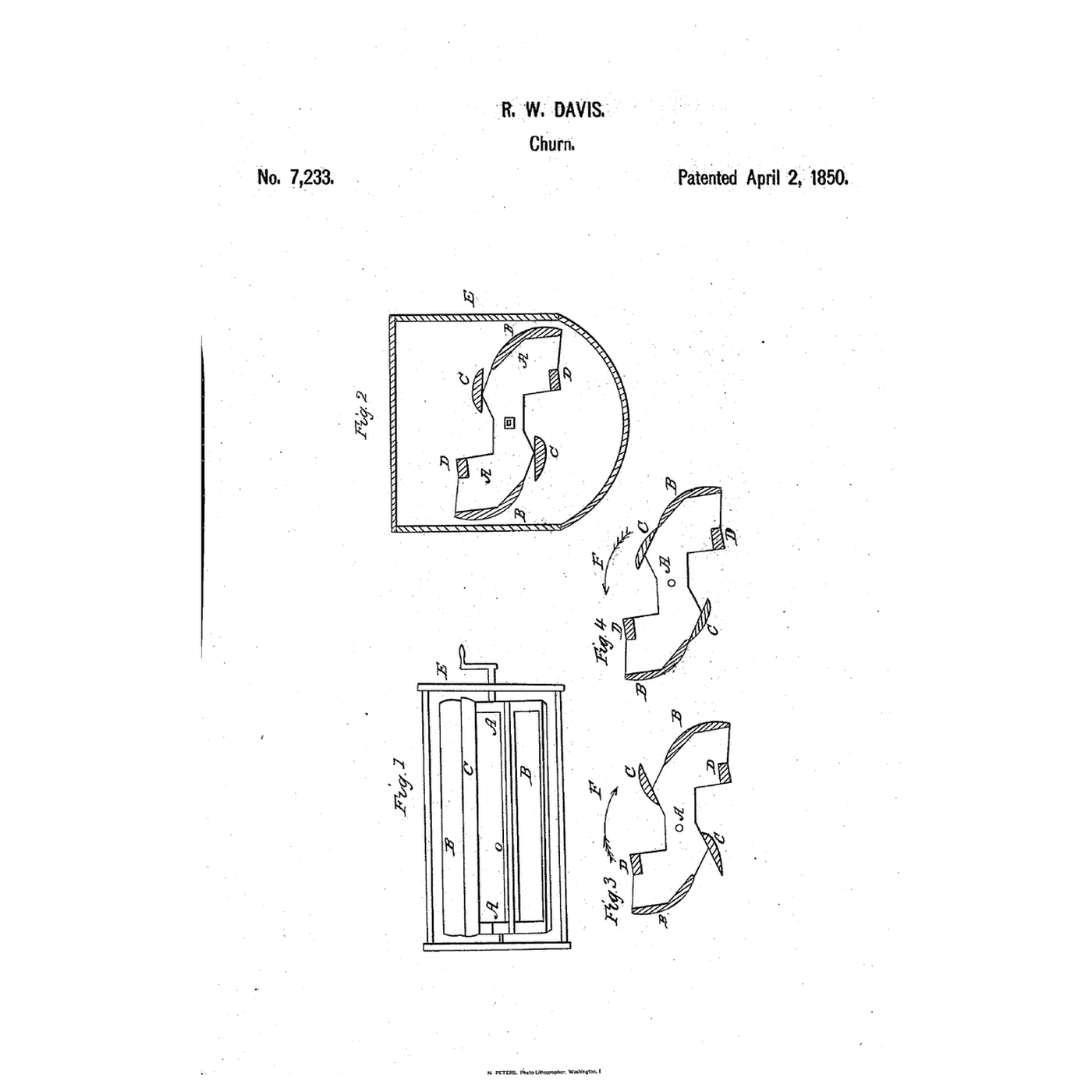
Davis wanted one dasher that would churn "in the most effectual manner," then gather the butter and work out the buttermilk.
Robert W. Davis of Rodgersville, New York, received US 7,233, dated 2 April 1850, for self-adjusting rotary churn-dashers. The dasher's fixed slats are set "at such angles as to force the cream toward the center"; movable floats hinged to its sides stand open when turning that way and move it outward, "which various and contrary motions so agitate it, that the butter is soon formed." Turned backward, the floats close on the slats so the outside forms "a uniform curve concentric to the axis," which throws the butter to the sides and bottom and presses it free of milk.
This rung looks at the floats' swing, then prints the sides, slats and floats, assembles the dasher in a box, and makes butter.
Intermediário
About 4 hours, plus printing
Instruções
1
1
The floats' swing
The floats' swing
A carregar o notebook Jupyter…
2
2
A dasher that churns one way and gathers the other before it
A dasher that churns one way and gathers the other before it
The embedded blueprint reverses fixed paired blades to roll the butter up. Davis lets hinged floats change shape by themselves when the crank is reversed.
3
3
Read US 7,233
Read US 7,233
"In order to gather the butter and work it, the dasher is then turned in the contrary direction, and the movable slats then closing the outside of the slats of the dasher form a uniform curve concentric to the axis and moving with the convex side foremost. By a few revolutions of the dasher the butter is thrown from the center to the sides and bottom of the churn box, and these gathered into a roll."
4
4
Print the parts
Print the parts
Print two side pieces (/uploads/blueprints/self-closing-float-dasher-churn-side.stl), four fixed slats (/uploads/blueprints/self-closing-float-dasher-churn-slat.stl), four curved floats with hinge eyes (/uploads/blueprints/self-closing-float-dasher-churn-float.stl) and the crank arm (/uploads/blueprints/self-closing-float-dasher-churn-crank-arm.stl). Print in PETG at 0.2 mm layers, 30 % infill, 4 walls; wash before first use.
Materiais para este passo:
 Filamento PETG1 peça
Ferramentas necessárias:
 Impressora 3D de filamento (FDM)
5
5
Assemble the dasher
Assemble the dasher
Slide the two side pieces onto a 10 mm square hardwood shaft 148 mm apart and screw the four slats between them. Hang each float between the arms' knuckles on a 3 mm stainless rod as its hinge, so it swings open one way and lies against its slat the other.
Materiais para este passo:
 Cavilhas de madeira dura1 peça
 Varão de aço macio1 peça
 Parafusos de máquina1 peça
 Cola de madeira1 peça
Ferramentas necessárias:
 Serra de arco para metais
 Conjunto de chaves de fendas
 Serrote
6
6
The box
The box
Take a food-safe box about 230 × 190 × 200 mm. Drill both ends on the axis 100 mm up, pass the shaft through with a leather washer at each end, and glue the crank arm and a dowel handle on.
Materiais para este passo:
 Recipiente de armazenamento de grau alimentar1 peça
 Tira de couro1 peçaCola de madeira1 peça
Ferramentas necessárias:
 Berbequim sem fios
 Jogo de brocas
7
7
The build in 3D
The build in 3D
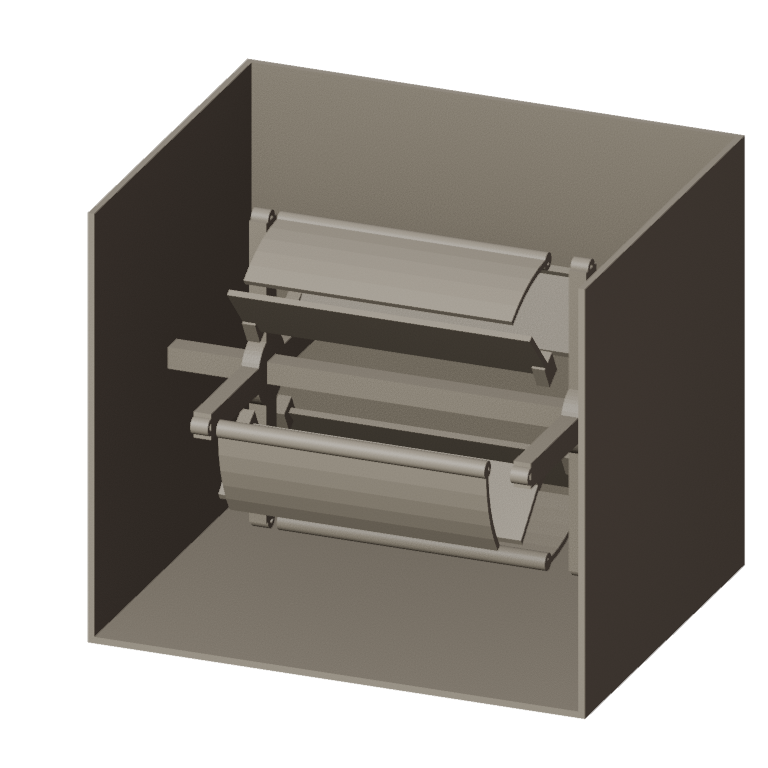
FreeCAD model of this build, not of the patent: the box with one side off to show the dasher's side pieces, the fixed slats and the hinged curved floats, and the crank.
8
8
Churn forward, gather backward
Churn forward, gather backward
Let the heavy cream stand until it reaches about 15 °C, checked with the thermometer. Pour in 1.5 litres. Crank forward, floats open; time until the butter comes. Then crank backward so the floats close and the round dasher gathers the butter into a roll; draw off the buttermilk and keep cranking to work it, as he did. Pour off the buttermilk, add cold water, churn a little and pour off again until it runs clear; work in a pinch of salt and weigh the butter.
Materiais para este passo:
 Natas para bater1500 ml
 Sal marinho grosso1 peça
 Água1 peça
Ferramentas necessárias:
 Termómetro de sonda permanente
 Cronómetro
 Balança digital de cozinha
 Taça grande de aço inoxidável
9
9
Floats that won't open or close
Floats that won't open or close
Self-closing float dasher troubleshooting.
Flow
Loading...
10
10
History and honest limits
History and honest limits
**Robert W. Davis** of Rodgersville, Steuben County, New York, received US 7,233, dated 2 April 1850. His drawing shows the dasher in a churn box with slats D strengthening it. He claimed "the self adjusting float or slat (C) which opens when churning the cream and closes of itself when the dasher is turned in the opposite direction to gather the butter."
**Honest limits.** A food-safe box and printed parts stand in for his wooden box and dasher. FDM prints hold food in their layer lines, so wash well and replace when worn. Your times and weights are the result.
Materiais
10- 1 peçaReferência
- 1 peçaReferência
- 1 peçaReferência
- 1 peçaReferência
- 2 peçasReferência
- Referência
- 1 peçaReferência
- 1500 mlReferência
- 1 peçaReferência
- 1 peçaReferência
Ferramentas necessárias
10- Referência
- Referência
- Referência
- Referência
- 1 vendor sell this, none ship to you yetReferência
- Referência
- Referência
- Referência
- Referência
- Referência
Ficheiros de design
1Blueprints relacionados
Estes blueprints compartilham conhecimento — técnicas, materiais ou princípios
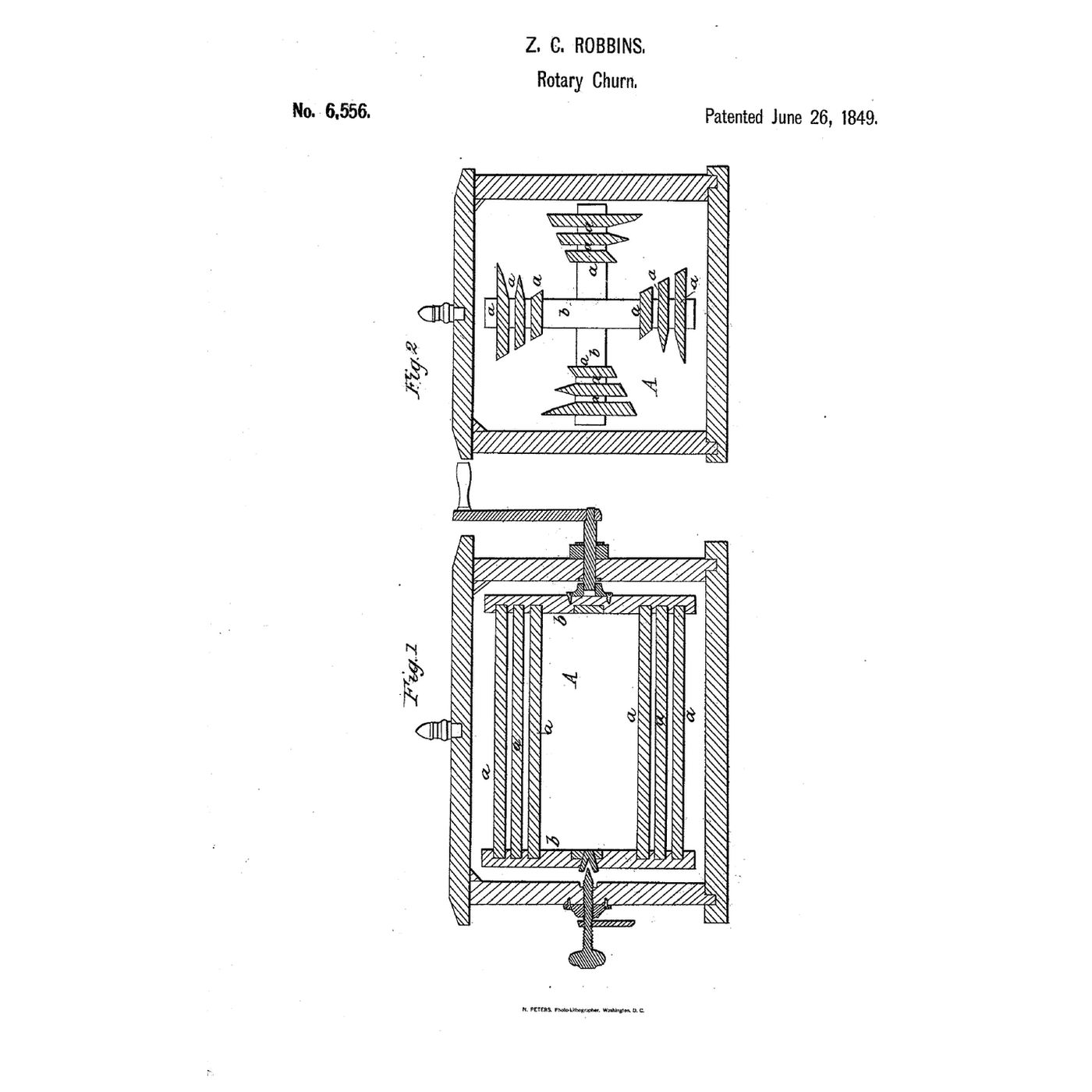
Telegraph Beater Churn: Nested Knife-Edged Beaters That Whip the Cream
por Martin
COMIDA E BEBIDAS
0
0
0
0
0
0
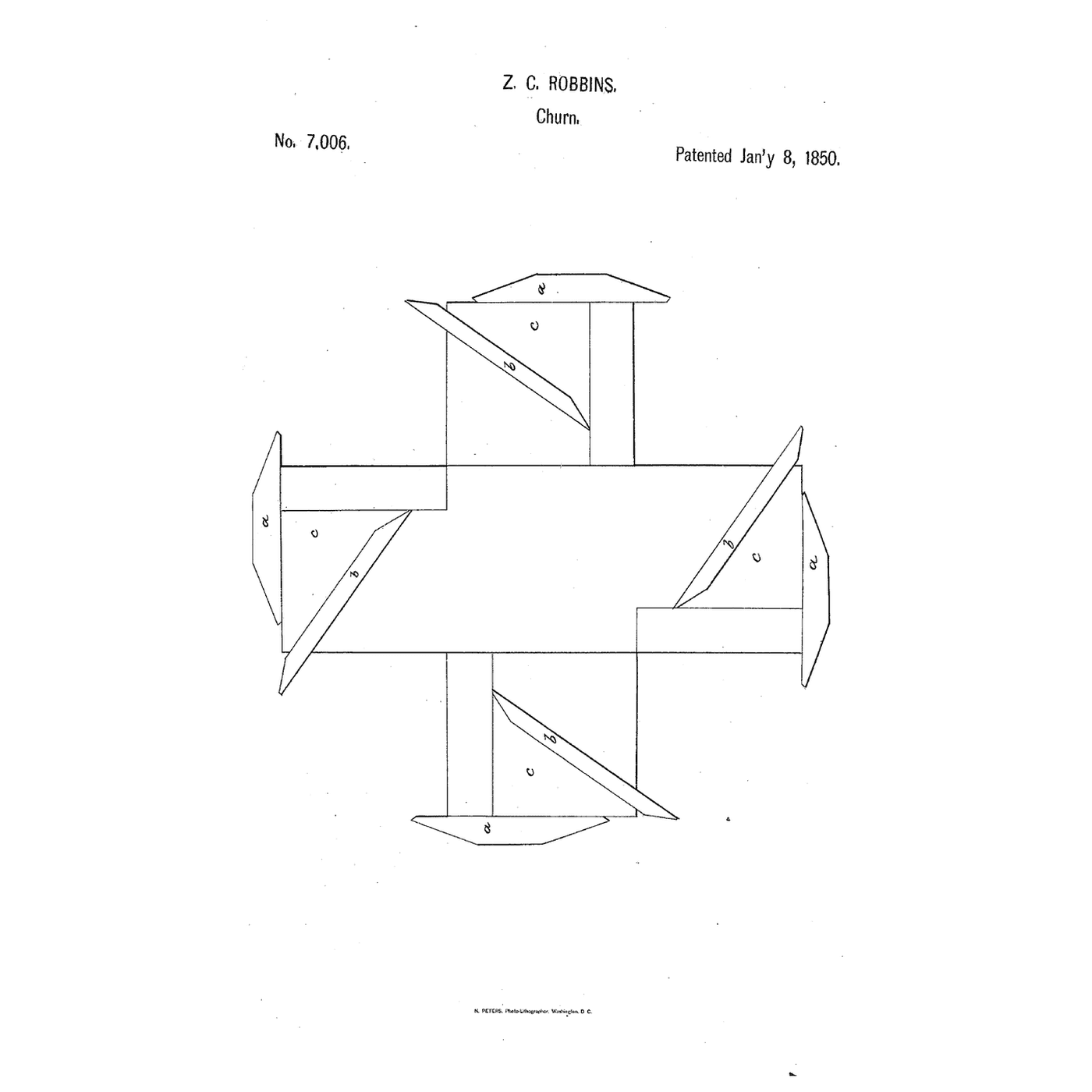
Centrifugal and Centripetal Churn Dasher: Paired Blades That Squeeze the Cream Through
por TheChef
COMIDA E BEBIDAS
1
0
0
0
0
0
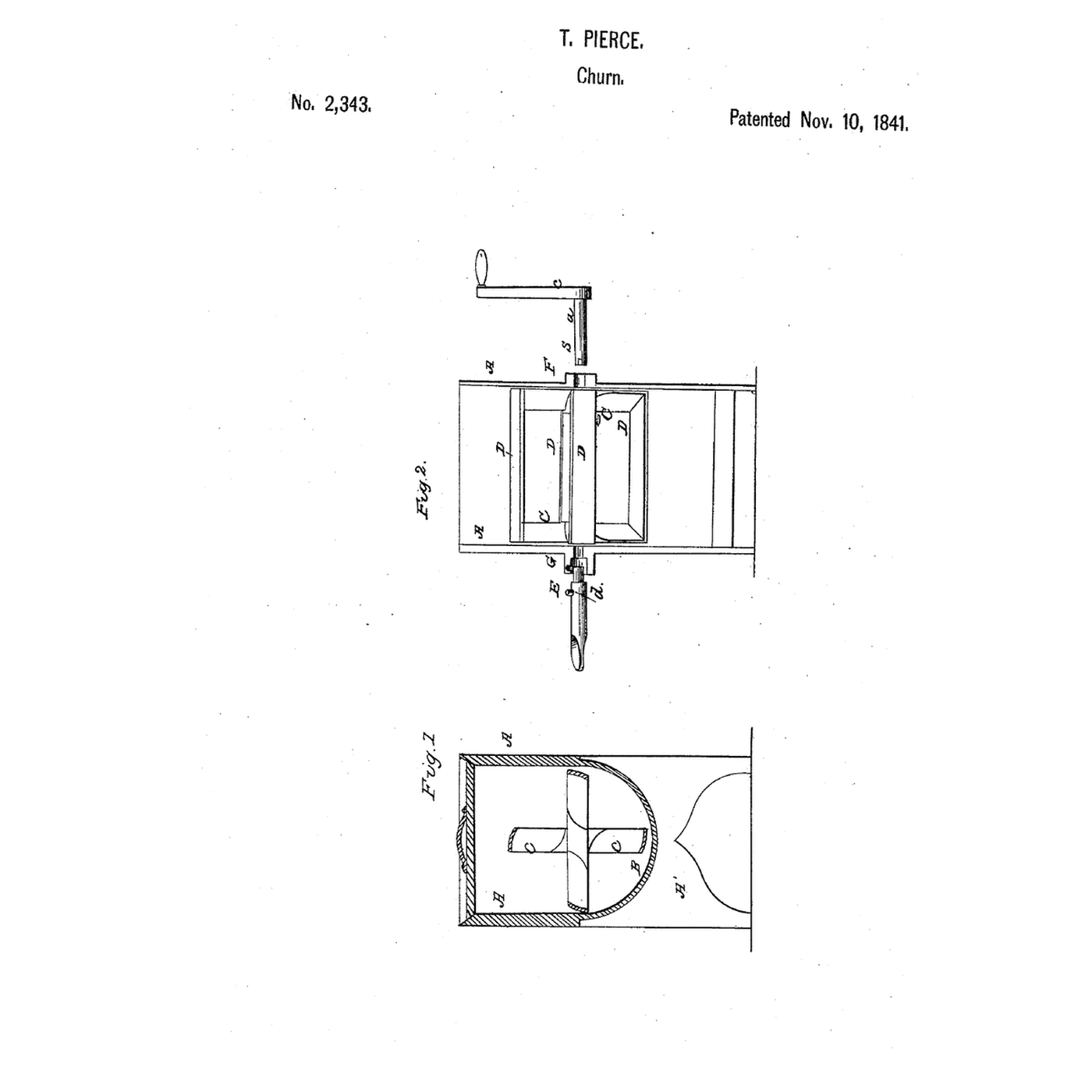
Shaftless Dasher-Wheel Churn: Bevelled Buckets Drive the Cream to the Centre
por Martin
COMIDA E BEBIDAS
1
0
0
0
0
0
CC0 Domínio Público
Este blueprint é liberado sob CC0. Você é livre para copiar, modificar, distribuir e usar este trabalho para qualquer finalidade, sem pedir permissão.
Apoie o Maker comprando produtos através do Blueprint, onde ele ganha uma Comissão Maker definida pelos vendedores, ou crie uma nova versão deste Blueprint e inclua-o como conexão no seu próprio Blueprint para compartilhar receita.