


Forging an Iron Chisel — The Cutting Tool That Shapes Stone, Wood, and Metal
The chisel is perhaps the most versatile tool ever forged. A blacksmith's cold chisel cuts iron on the anvil. A mason's point chisel dresses stone blocks. A carpenter's firmer chisel shapes timber joints. In every case, the principle is the same: a hardened steel or iron edge driven by a hammer blow concentrates force onto a line, splitting the material along that line.
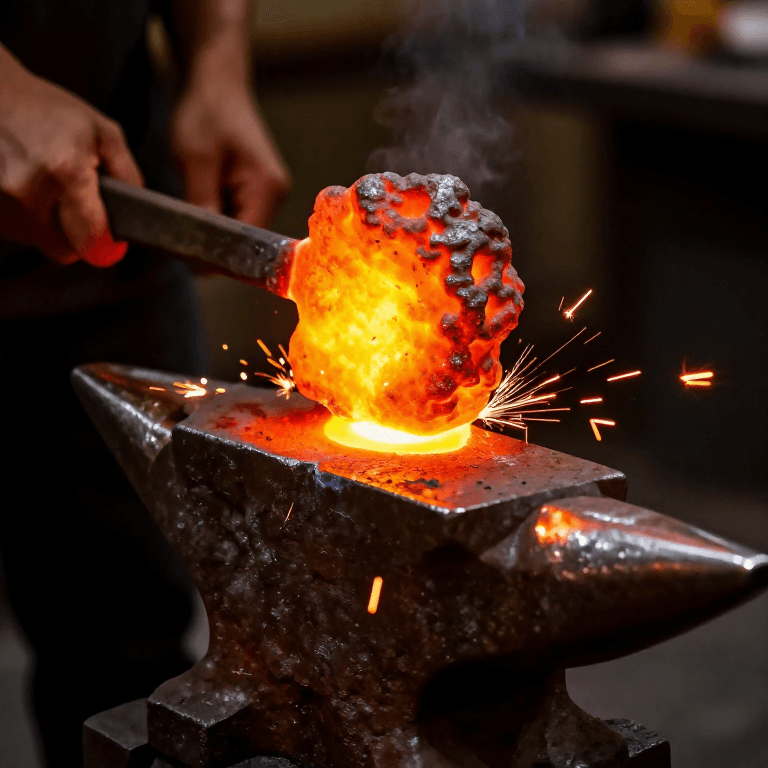
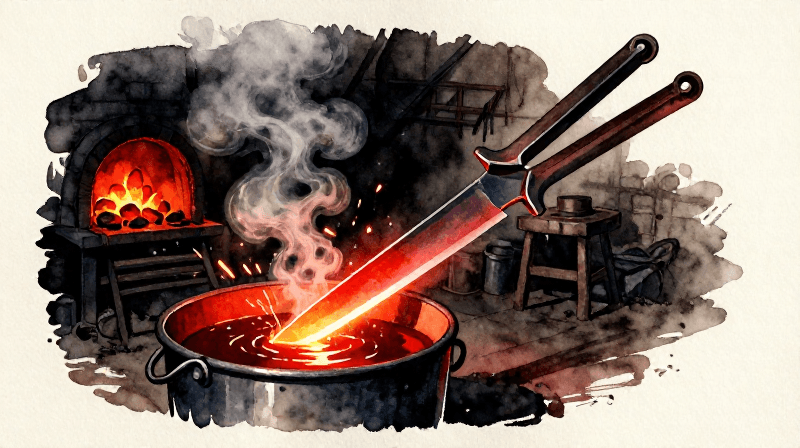
An iron chisel is forged from a single bar of wrought iron: one end is drawn to a flat wedge for the cutting edge, the other end is left square as the striking head. The critical technique is case-carburising the cutting end — packing it in charcoal and heating it to absorb carbon, converting the surface layer from soft wrought iron into hardenable steel. This steel edge is then quench-hardened and tempered, giving the chisel a hard cutting face backed by a tough, shock-absorbing body.
说明
Select and cut the bar stock
Select and cut the bar stock
Forge the cutting end to a wedge
Forge the cutting end to a wedge
此步骤所需材料:
 木炭3 公斤
所需工具:
 锻打锤
锻打锤 锻造钳
锻造钳 炉膛(锻火)
Form the striking head
Form the striking head
Straighten and true
Straighten and true
Case-carburise the cutting end
Case-carburise the cutting end
Quench-harden the edge
Quench-harden the edge
此步骤所需材料:
 水5 l
水5 lTemper the hardened edge
Temper the hardened edge
所需工具:
 砂岩(磨料)
Grind the final edge
Grind the final edge
所需工具:
 磨刀石
磨刀石已连接蓝图材料
此蓝图制作
相关蓝图
这些蓝图共享知识——技术、材料或原理
CC0 公共领域
此蓝图以 CC0 协议发布。你可以自由复制、修改、分发和使用此作品,无需征得许可。
通过购买蓝图中的产品支持创客,他们将获得 创客佣金 (由供应商设定),或创建此蓝图的新版本并将其作为连接包含在你自己的蓝图中以分享收入。