
KUNST
SCHÖNHEIT & WELLNESS
HANDWERK
KULTUR & GESCHICHTE
UNTERHALTUNG
UMFELD
ESSEN & GETRÄNKE
REVERSE ENGINEERING
WISSENSCHAFTEN
SPORT
TECHNOLOGIE
WEARABLES
Hinged-Beater Swivel Dasher: Beaters That Tilt Rising and Lie Flat Falling
YourGrandma

Erstellt von

YourGrandma

6. Oktober 2026IS
29
0
0
0
0

Hinged-Beater Swivel Dasher: Beaters That Tilt Rising and Lie Flat Falling

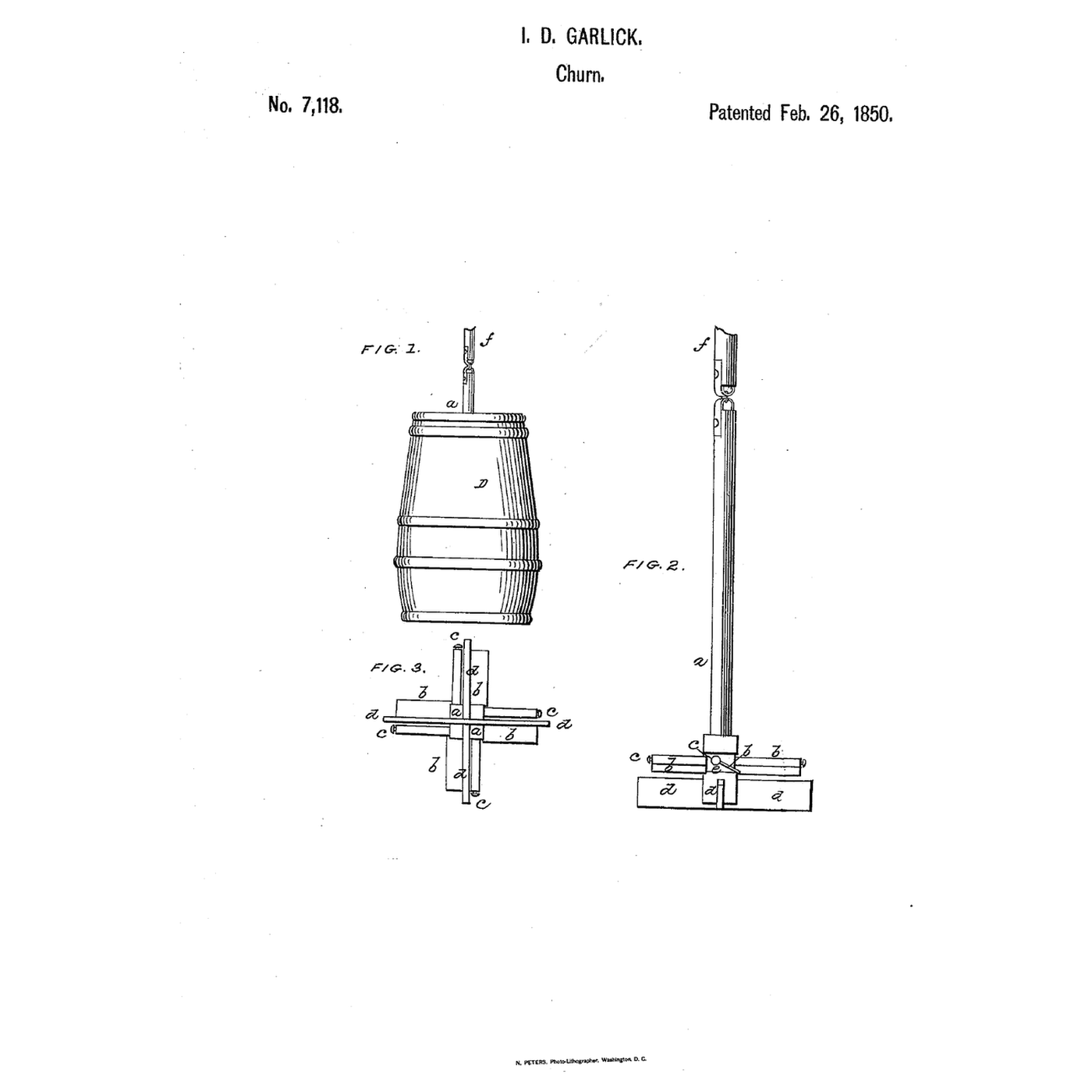
Garlick made a common up-and-down dash that also turns as it rises. Isaac D. Garlick of Lyons, New York, received US 7,118, dated 26 February 1850, for a churn-dasher whose rod is in two parts joined by a swivel. At the foot are four radial wings; above them, in recesses in the rod's four sides, four vibrating metal beaters hang on pins. Rising, they fall to "angles with the dasher rod of from forty to forty five degrees" and "impart a rotary movement to the dasher"; falling, they are thrown to "horizontal positions, at right angles with the dasher rod." This rung compares the beaters' two positions, then prints the head, beaters and swivel, assembles the dash, and makes butter in a bucket.
Anfänger
About 2 hours, plus printing

Anweisungen

1

Two positions

Jupyter-Notebook wird geladen …
2

A dasher that turns as it moves up and down before it

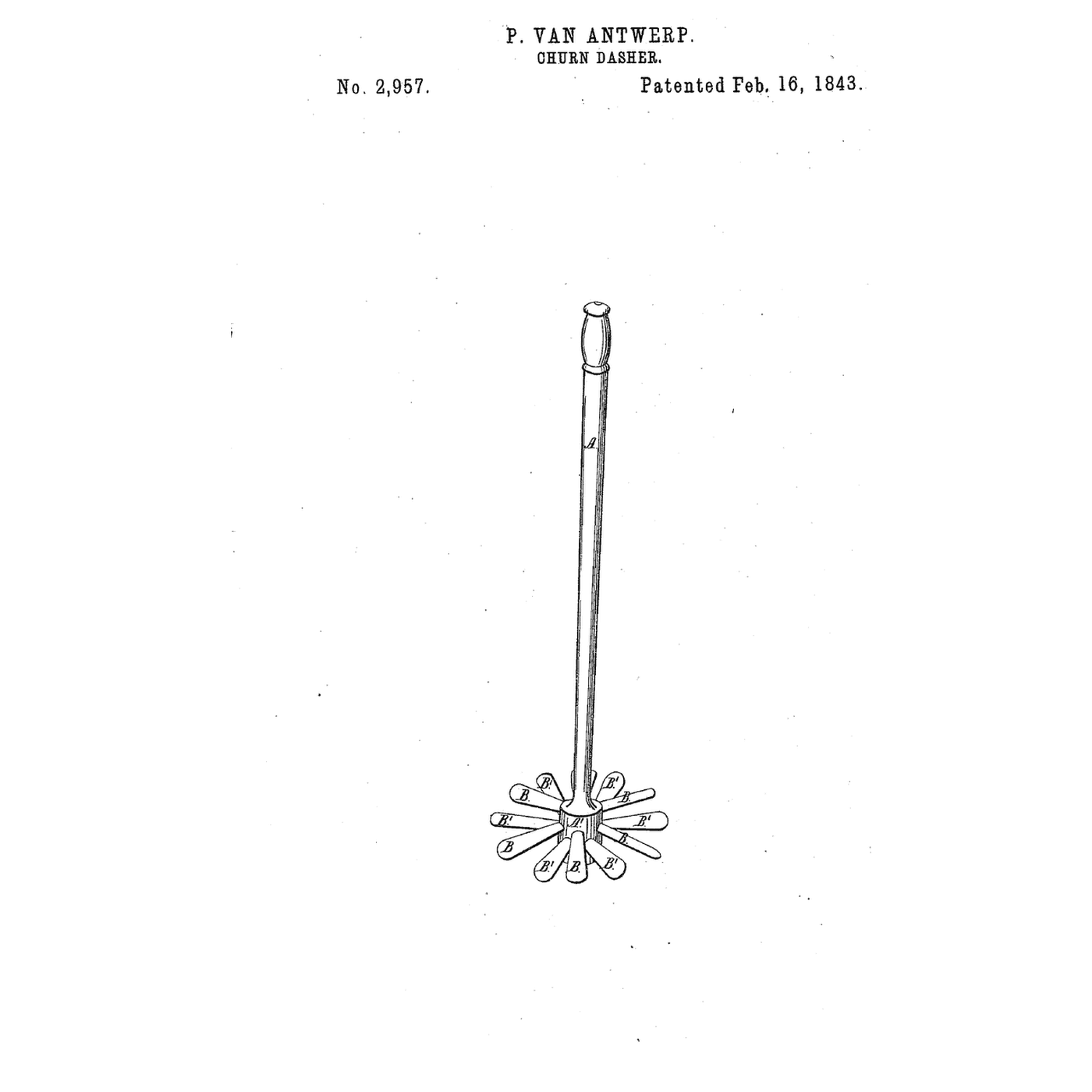
The embedded blueprint turns its dasher with a pin in a spiral slot. Garlick's hinged beaters turn it from the cream's own push, so the rod needs a swivel.
3

Read US 7,118

"When the dasher is operated in cream, the upward movement thereof will throw the beaters b, b, into the inclined position represented in Fig. 2, by which they will impart a rotary movement to the dasher, and thereby cause the vertical faces of the wings d, d, to aid in efficiently acting upon and agitating the cream during their upward movement; and when the dasher is forced downward, the beaters b, b, will be thrown into a horizontal position."
4

Print the parts

Print the head: a block with four radial wings and four recesses, each with a pin hole across its top. Print four beaters with their hinge eyes, and the swivel. Print in PETG at 0.2 mm layers, 30 % infill, 4 walls; wash before first use.

Materialien für diesen Schritt:

PETG-FilamentPETG-Filament1 Stück

Benötigte Werkzeuge:

FDM-3D-DruckerFDM-3D-Drucker
5

Print the head

The head, printed as step 4 describes.
DesigndateiSTLCC0 - Free
6

Print the beater

The beater, printed as step 4 describes.
DesigndateiSTLCC0 - Free
7

Print the swivel

The swivel, printed as step 4 describes.
DesigndateiSTLCC0 - Free
8

Hang the beaters

Set each beater's eye in its recess and push a 2 mm stainless pin (a cut nail will do) through the head and eye, so the beater swings freely between hanging at 40–45° and lying flat against the recess's top.

Materialien für diesen Schritt:

NägelNägel1 Stück

Benötigte Werkzeuge:

Bügelsäge (Metallsäge)Bügelsäge (Metallsäge)
SchleifpapierSchleifpapier
9

Rod and swivel

Glue a 12 mm hardwood dowel into the head as the lower rod. Join a second dowel to it with the swivel: glue the upper dowel into the swivel's top socket and let the lower dowel turn freely in its bottom socket, held by a small screw in a groove. Drill a bucket lid for the rod.

Materialien für diesen Schritt:

HartholzdübelHartholzdübel1 Stück
HolzleimHolzleim1 Stück
Holzschraube #8 x 1"Holzschraube #8 x 1"1 Stück
20-Liter-Eimer20-Liter-Eimer1 Stück

Benötigte Werkzeuge:

HandsägeHandsäge
AkkubohrschrauberAkkubohrschrauber
BohrersatzBohrersatz
Schraubendreher-SatzSchraubendreher-Satz
10

The build in 3D

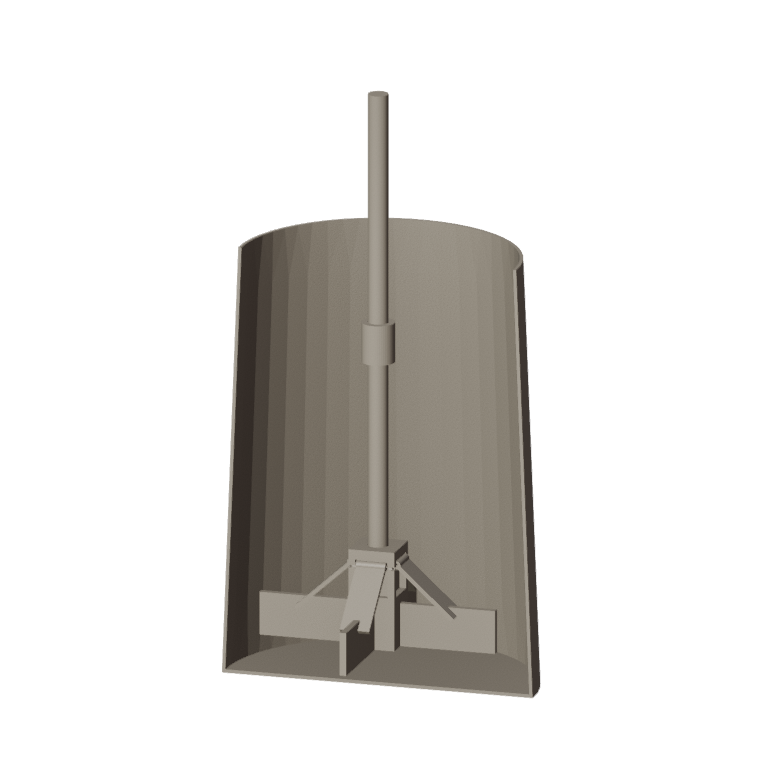
FreeCAD model of this build, not of the patent: the tub cut away to show the head with its four wings and four hinged beaters hanging at about 42°, the lower rod, the swivel and the upper rod.
DesigndateiBLENDCC0 - Free
11

Dash and make butter

Let the heavy cream stand until it reaches about 15 °C, checked with the thermometer. Pour in 2 litres. Work the upper rod up and down; the lower part should turn a little on each up-stroke. Time until the butter comes. Pour off the buttermilk, add cold water, churn a little and pour off again until it runs clear; work in a pinch of salt and weigh the butter.
Schritt 11 - Image 1

Materialien für diesen Schritt:

SchlagsahneSchlagsahne2000 ml
Grobes MeersalzGrobes Meersalz1 Stück
WasserWasser1 Stück

Benötigte Werkzeuge:

Einsteck-FühlerthermometerEinsteck-Fühlerthermometer
StoppuhrStoppuhr
Digitale KüchenwaageDigitale Küchenwaage
Große Rührschüssel aus EdelstahlGroße Rührschüssel aus Edelstahl
12

Beaters that stick, a dash that won't turn

Hinged-beater swivel dasher troubleshooting.

Flow

Loading...
13

History and honest limits

**Isaac D. Garlick** of Lyons, Wayne County, New York, received US 7,118, dated 26 February 1850, signed 19 December 1849. His churn was a staved upright tub; the rod's upper part could be worked by hand or by machinery; the beaters were metal, hung by a rod through eyes "or a continuous beading on one edge." He claimed hinging the beaters so they are thrown inclined by the upward and horizontal by the downward movement, combined with the vertical-faced wings on the same rod. **Honest limits.** Printed beaters and head stand in for his metal beaters and wooden rod; a bucket for his tub. FDM prints hold food in their layer lines, so wash well and replace when worn. Your times and weights are the result.

Materialien

9

Benötigte Werkzeuge

11

Designdateien

4

Dieser Bauplan stellt her

CC0 Gemeinfrei

Dieser Blueprint ist unter CC0 veröffentlicht. Sie dürfen dieses Werk für jeden Zweck frei kopieren, ändern, verbreiten und verwenden, ohne um Erlaubnis zu fragen.

Unterstützen Sie den Maker, indem Sie Produkte über seinen Blueprint kaufen, wo er eine Maker-Provision von Anbietern festgelegt, verdient. Oder erstellen Sie eine neue Iteration dieses Blueprints und verbinden Sie ihn in Ihrem eigenen Blueprint, um Einnahmen zu teilen.

Diskussion

(0)

Anmelden um an der Diskussion teilzunehmen

Kommentare werden geladen...