KUNST
SCHÖNHEIT & WELLNESS
HANDWERK
KULTUR & GESCHICHTE
UNTERHALTUNG
UMFELD
ESSEN & GETRÄNKE
REVERSE ENGINEERING
WISSENSCHAFTEN
SPORT
TECHNOLOGIE
WEARABLES

Wedge-Plunger Potato Strainer: Turn a Wedge, the Mash Comes Out the Sides
A plunger pushed straight down a strainer packs the potato and forces it only through the bottom.
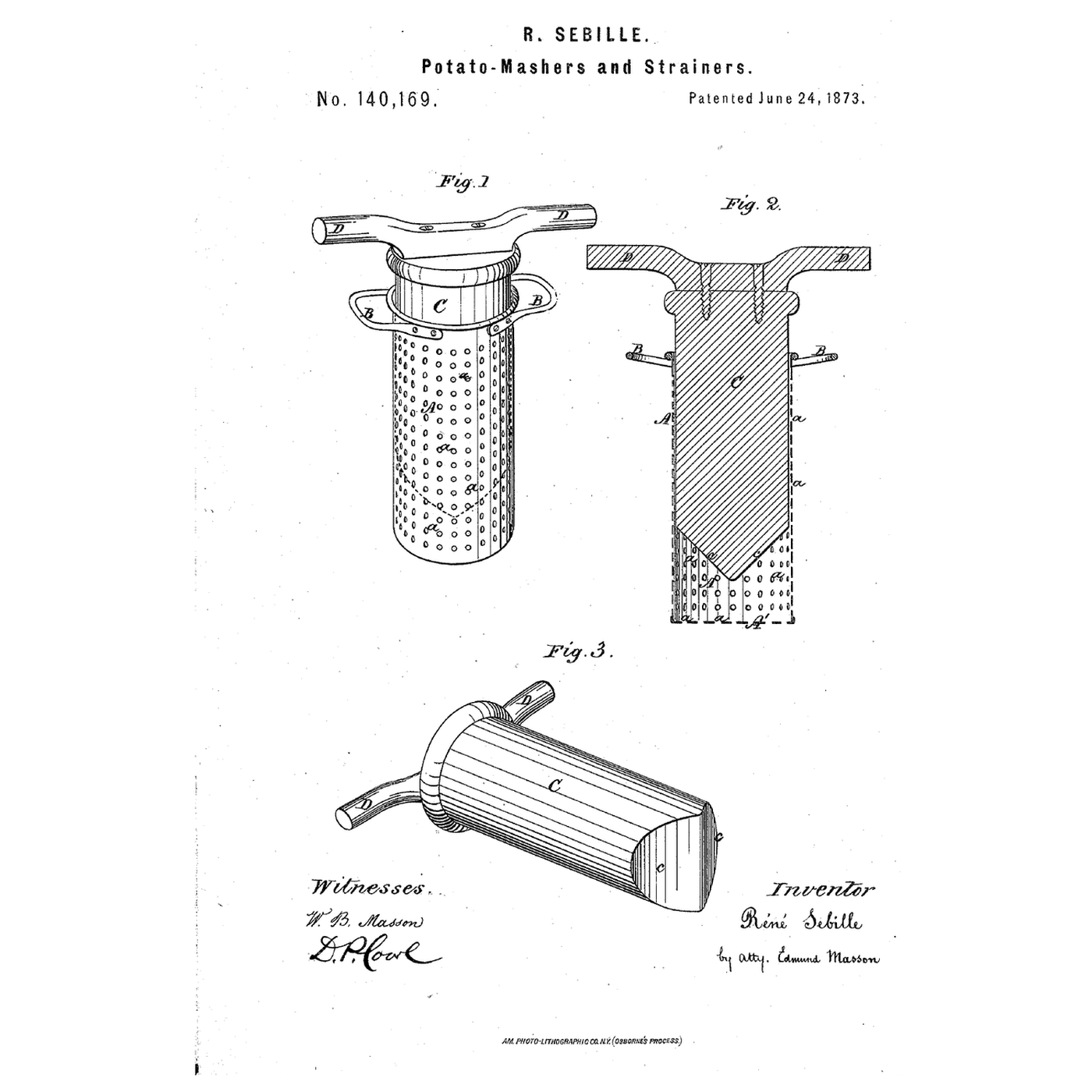
René Sebille of Baltimore received US 140,169, dated 24 June 1873, for a potato masher and strainer: a cylindrical strainer perforated all round its side and bottom, "through which the potato-mash can issue as fast as it is produced," and a plunger whose end is a wedge with two bevel faces, turned back and forth by two handles while pressed down, so it can be worked "with the least possible amount of power."
This rung works out where the outlet area is, then prints the strainer and plunger and times a batch.
Anfänger
About 1 hour, plus printing
Anweisungen
1
1
Side and bottom outlets
Side and bottom outlets
Jupyter-Notebook wird geladen …
2
2
A tube and plunger before it
A tube and plunger before it
The embedded blueprint pushes a flat plunger down a tube. Sebille perforates the sides too and turns a wedge instead of pushing.
3
3
Read US 140,169
Read US 140,169
"The plunger is then rotated back and forth by means of the handles D D, at the same time that a certain amount of pressure is exerted downward upon it. By this motion the bevel faces c c of the plunger displace and mash the potatoes, and force them through the openings a of the strainer, the peculiar double-bevel-faced shape of the plunger making it easy to accomplish the desideratum with the smallest amount of power, and yet very expeditiously."
4
4
Print the strainer and plunger
Print the strainer and plunger
Print the perforated strainer with its handles and the plunger with its wedge end and cross handle. Print in PETG at 0.2 mm layers, 30 % infill, 4 walls; wash before first use.
Materialien für diesen Schritt:
 PETG-Filament1 Stück
Benötigte Werkzeuge:
 FDM-3D-Drucker
5
5
Print the strainer
Print the strainer
The strainer, printed as step 4 describes.
6
6
Print the plunger
Print the plunger
The plunger, printed as step 4 describes.
7
7
The build in 3D
The build in 3D
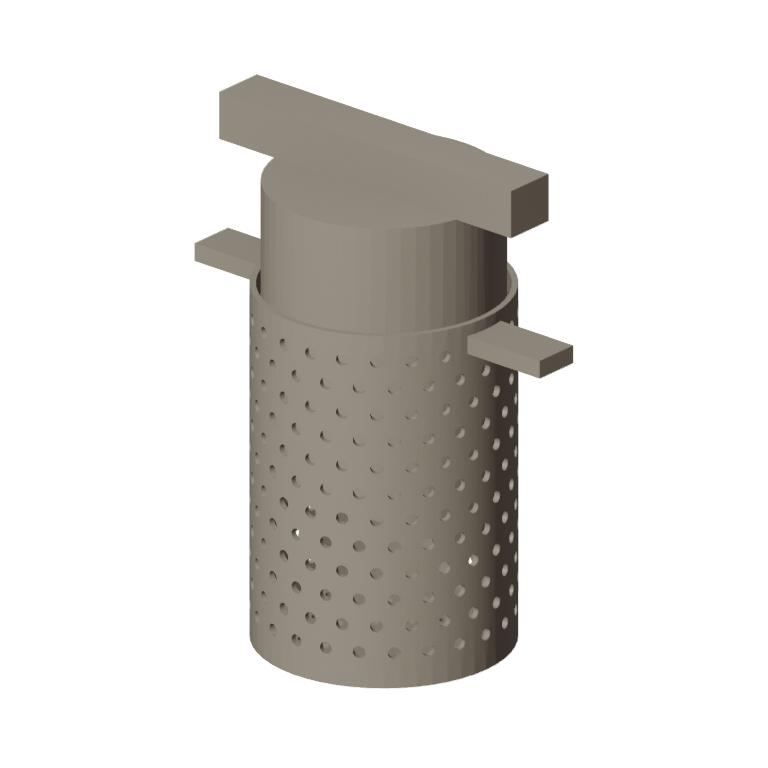
FreeCAD model of this build, not of the patent: the 80 mm strainer with 288 side holes and a bottom grid of 4 mm holes and two handles, and the plunger with its double-bevel wedge and cross handle.
8
8
Cook the potatoes
Cook the potatoes
Boil 500 g of potatoes, peeled and quartered, for about 20 minutes until a knife slides in; drain.
Materialien für diesen Schritt:
 Kartoffeln1 Stück
 Wasser1 Stück
Benötigte Werkzeuge:
 Stielkasserolle
 Digitale Küchenwaage
9
9
Turn and press
Turn and press
Stand the strainer in a bowl, fill it with hot potato, and turn the plunger to and fro with light pressure. Time the batch; then repeat pushing straight down only.
Benötigte Werkzeuge:
 Große Rührschüssel aus Edelstahl
 Stoppuhr
10
10
A plunger that jams, a strainer that clogs
A plunger that jams, a strainer that clogs
Wedge-plunger potato strainer troubleshooting.
Flow
Loading...
11
11
History and honest limits
History and honest limits
**René Sebille** of Baltimore filed US 140,169 on 5 May 1873; it is dated 24 June 1873. The strainer can be held by its handles, given legs to stand over a dish, or fastened to a table; the plunger is cylindrical for most of its length to bear on the sides, though the wedge end with a short cylinder may be fixed to a long handle. He claimed the double-bevel plunger with the strainer.
**Honest limits.** A printed strainer stands in for his tin one. FDM prints hold food in their layer lines, so wash well and replace when worn. Your times are the result.
Materialien
3- 1 StückPlatzhalter
- 1 StückPlatzhalter
- 1 StückPlatzhalter
Benötigte Werkzeuge
5- Platzhalter
- Platzhalter
- Platzhalter
- Platzhalter
- Platzhalter
Designdateien
3Dieser Bauplan stellt her
Verwandte Blueprints
Diese Blueprints teilen Wissen — Techniken, Materialien oder Prinzipien
Draining-Tube Potato Masher: Mash in a Tube, the Water Runs Out
von YourGrandma
ESSEN & GETRÄNKE
29
0
0
0
0
0
Peel-Sieve Potato Masher: Press Through the Net, Leave the Peel
von Martin
ESSEN & GETRÄNKE
29
0
0
0
0
0
Yielding-Disk Potato Masher: A Perforated Disk That Rocks to the Mash
von TheChef
ESSEN & GETRÄNKE
41
0
0
0
0
0
CC0 Gemeinfrei
Dieser Blueprint ist unter CC0 veröffentlicht. Sie dürfen dieses Werk für jeden Zweck frei kopieren, ändern, verbreiten und verwenden, ohne um Erlaubnis zu fragen.
Unterstützen Sie den Maker, indem Sie Produkte über seinen Blueprint kaufen, wo er eine Maker-Provision von Anbietern festgelegt, verdient. Oder erstellen Sie eine neue Iteration dieses Blueprints und verbinden Sie ihn in Ihrem eigenen Blueprint, um Einnahmen zu teilen.