ARTE
BELLEZA Y BIENESTAR
ARTESANÍA
CULTURA E HISTORIA
ENTRETENIMIENTO
MEDIO AMBIENTE
COMIDA Y BEBIDAS
INGENIERÍA INVERSA
CIENCIAS
DEPORTES
TECNOLOGÍA
TECNOLOGÍA VESTIBLE

Wedge-Plunger Potato Strainer: Turn a Wedge, the Mash Comes Out the Sides
A plunger pushed straight down a strainer packs the potato and forces it only through the bottom.
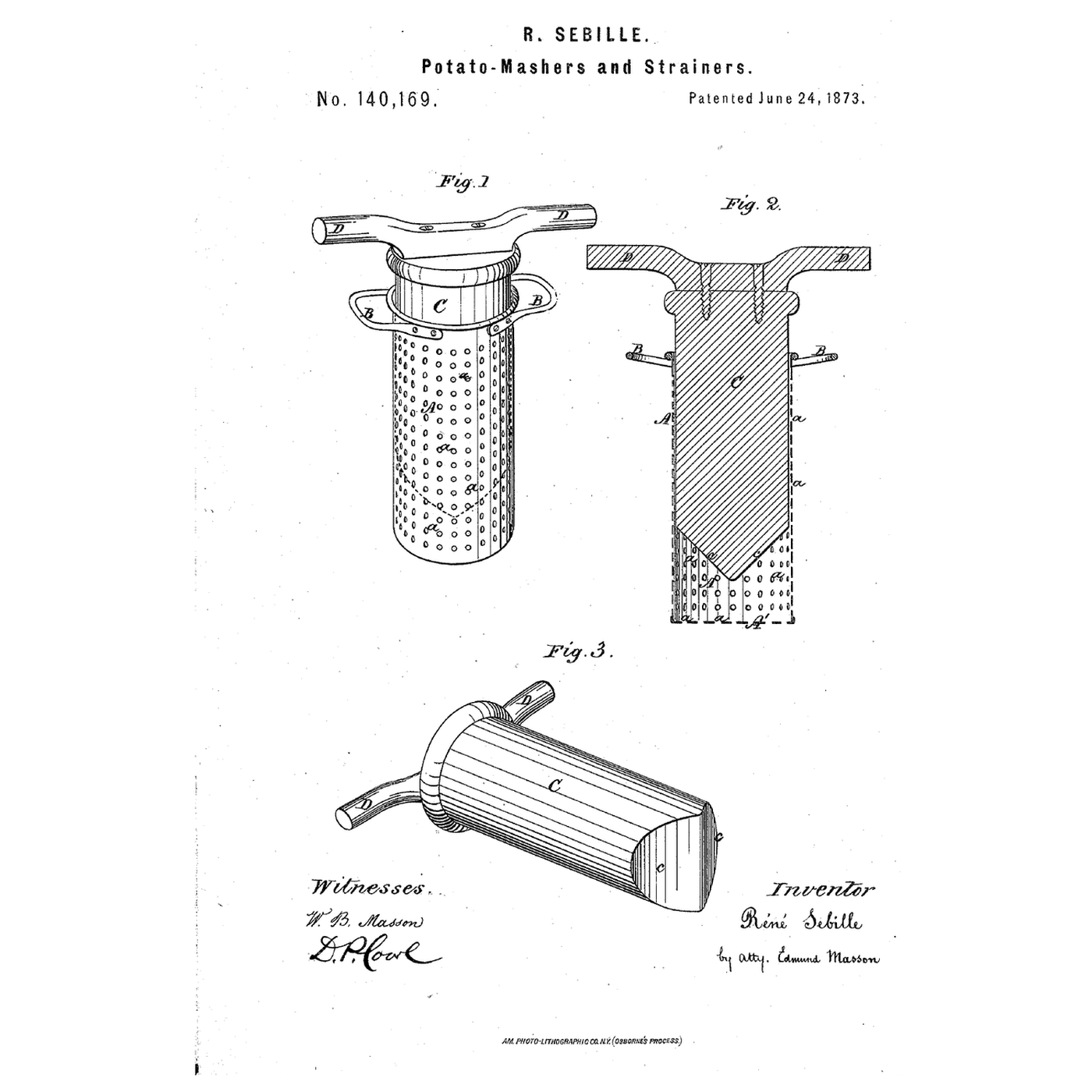
René Sebille of Baltimore received US 140,169, dated 24 June 1873, for a potato masher and strainer: a cylindrical strainer perforated all round its side and bottom, "through which the potato-mash can issue as fast as it is produced," and a plunger whose end is a wedge with two bevel faces, turned back and forth by two handles while pressed down, so it can be worked "with the least possible amount of power."
This rung works out where the outlet area is, then prints the strainer and plunger and times a batch.
Principiante
About 1 hour, plus printing
Instrucciones
1
1
Side and bottom outlets
Side and bottom outlets
Cargando el cuaderno de Jupyter…
2
2
A tube and plunger before it
A tube and plunger before it
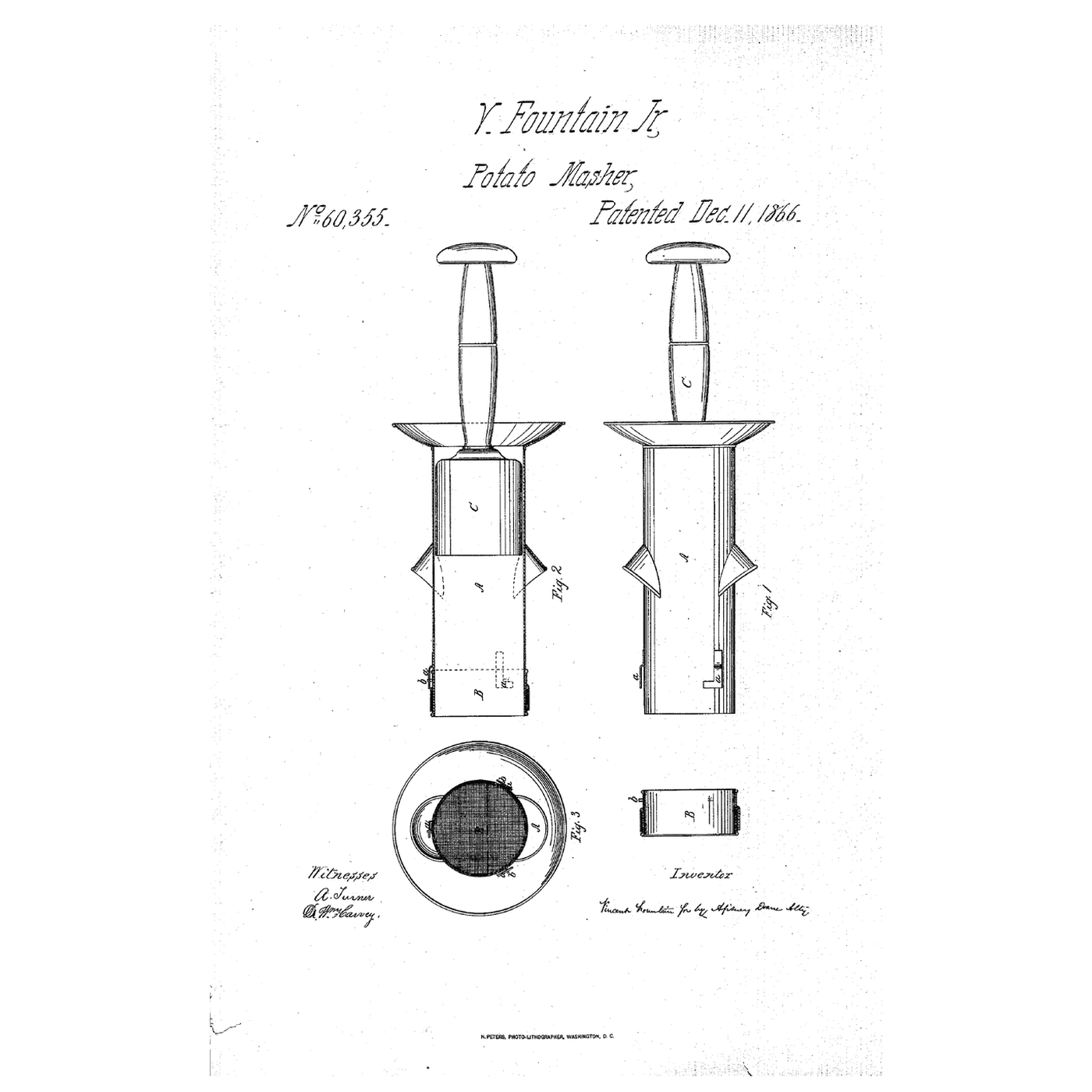
The embedded blueprint pushes a flat plunger down a tube. Sebille perforates the sides too and turns a wedge instead of pushing.
3
3
Read US 140,169
Read US 140,169
"The plunger is then rotated back and forth by means of the handles D D, at the same time that a certain amount of pressure is exerted downward upon it. By this motion the bevel faces c c of the plunger displace and mash the potatoes, and force them through the openings a of the strainer, the peculiar double-bevel-faced shape of the plunger making it easy to accomplish the desideratum with the smallest amount of power, and yet very expeditiously."
4
4
Print the strainer and plunger
Print the strainer and plunger
Print the perforated strainer with its handles and the plunger with its wedge end and cross handle. Print in PETG at 0.2 mm layers, 30 % infill, 4 walls; wash before first use.
Materiales para este paso:
 Filamento PETG1 pieza
Herramientas necesarias:
 Impresora 3D de filamento (FDM)
5
5
Print the strainer
Print the strainer
The strainer, printed as step 4 describes.
6
6
Print the plunger
Print the plunger
The plunger, printed as step 4 describes.
7
7
The build in 3D
The build in 3D
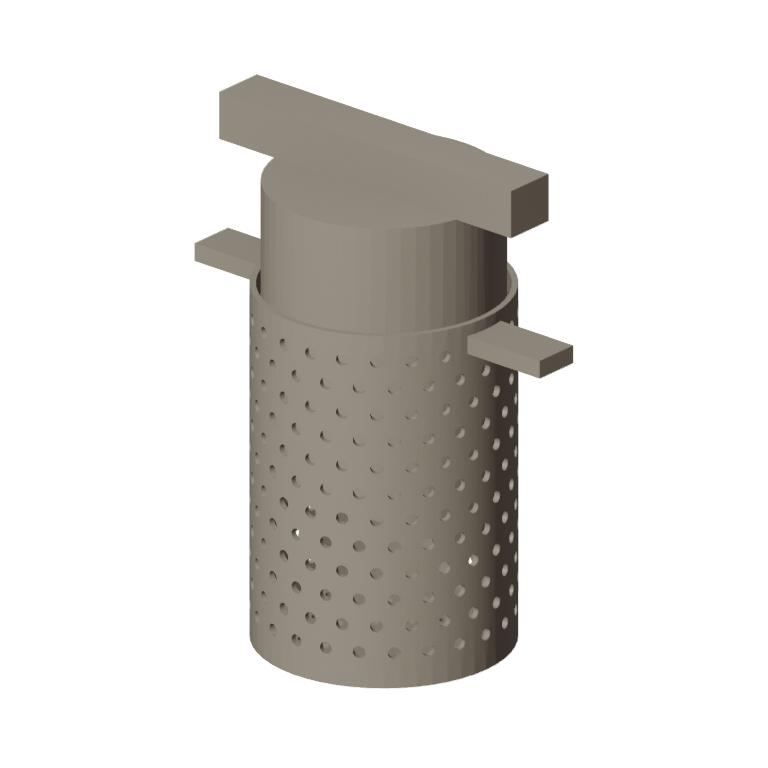
FreeCAD model of this build, not of the patent: the 80 mm strainer with 288 side holes and a bottom grid of 4 mm holes and two handles, and the plunger with its double-bevel wedge and cross handle.
8
8
Cook the potatoes
Cook the potatoes
Boil 500 g of potatoes, peeled and quartered, for about 20 minutes until a knife slides in; drain.
Materiales para este paso:
 Patatas1 pieza
 Agua1 pieza
Herramientas necesarias:
 Cazo alto
 Báscula digital de cocina
9
9
Turn and press
Turn and press
Stand the strainer in a bowl, fill it with hot potato, and turn the plunger to and fro with light pressure. Time the batch; then repeat pushing straight down only.
Herramientas necesarias:
 Bol grande de acero inoxidable
 Cronómetro
10
10
A plunger that jams, a strainer that clogs
A plunger that jams, a strainer that clogs
Wedge-plunger potato strainer troubleshooting.
Flow
Loading...
11
11
History and honest limits
History and honest limits
**René Sebille** of Baltimore filed US 140,169 on 5 May 1873; it is dated 24 June 1873. The strainer can be held by its handles, given legs to stand over a dish, or fastened to a table; the plunger is cylindrical for most of its length to bear on the sides, though the wedge end with a short cylinder may be fixed to a long handle. He claimed the double-bevel plunger with the strainer.
**Honest limits.** A printed strainer stands in for his tin one. FDM prints hold food in their layer lines, so wash well and replace when worn. Your times are the result.
Materiales
3- 1 piezaMarcador de posición
- 1 piezaMarcador de posición
- 1 piezaMarcador de posición
Herramientas requeridas
5- Marcador de posición
- Marcador de posición
- Marcador de posición
- Marcador de posición
- Marcador de posición
Archivos de diseño
3Este plano hace
Blueprints relacionados
Estos blueprints comparten conocimiento — técnicas, materiales o principios
Draining-Tube Potato Masher: Mash in a Tube, the Water Runs Out
por YourGrandma
COMIDA Y BEBIDAS
29
0
0
0
0
0
Peel-Sieve Potato Masher: Press Through the Net, Leave the Peel
por Martin
COMIDA Y BEBIDAS
29
0
0
0
0
0
Yielding-Disk Potato Masher: A Perforated Disk That Rocks to the Mash
por TheChef
COMIDA Y BEBIDAS
41
0
0
0
0
0
CC0 Dominio público
Este Blueprint se publica bajo CC0. Eres libre de copiar, modificar, distribuir y usar este trabajo para cualquier propósito, sin pedir permiso.
Apoya al Maker comprando productos a través de su Blueprint, donde gana una Comisión del Maker establecida por los vendedores, o crea una nueva iteración de este Blueprint e inclúyela como conexión en tu propio Blueprint para compartir ingresos.