
ARTE
BELLEZZA E BENESSERE
MESTIERE
CULTURA E STORIA
DIVERTIMENTO
AMBIENTE
CIBO E BEVANDE
INGEGNERIA INVERSA
SCIENZE
SPORT
TECNOLOGIA
INDOSSABILI
Piston-Float Air Churn: Hollow Floats With Pistons Worked by a Fixed Eccentric
Emma

Creato da

Emma

6. ottobre 2026SE
33
0
0
0
0

Piston-Float Air Churn: Hollow Floats With Pistons Worked by a Fixed Eccentric

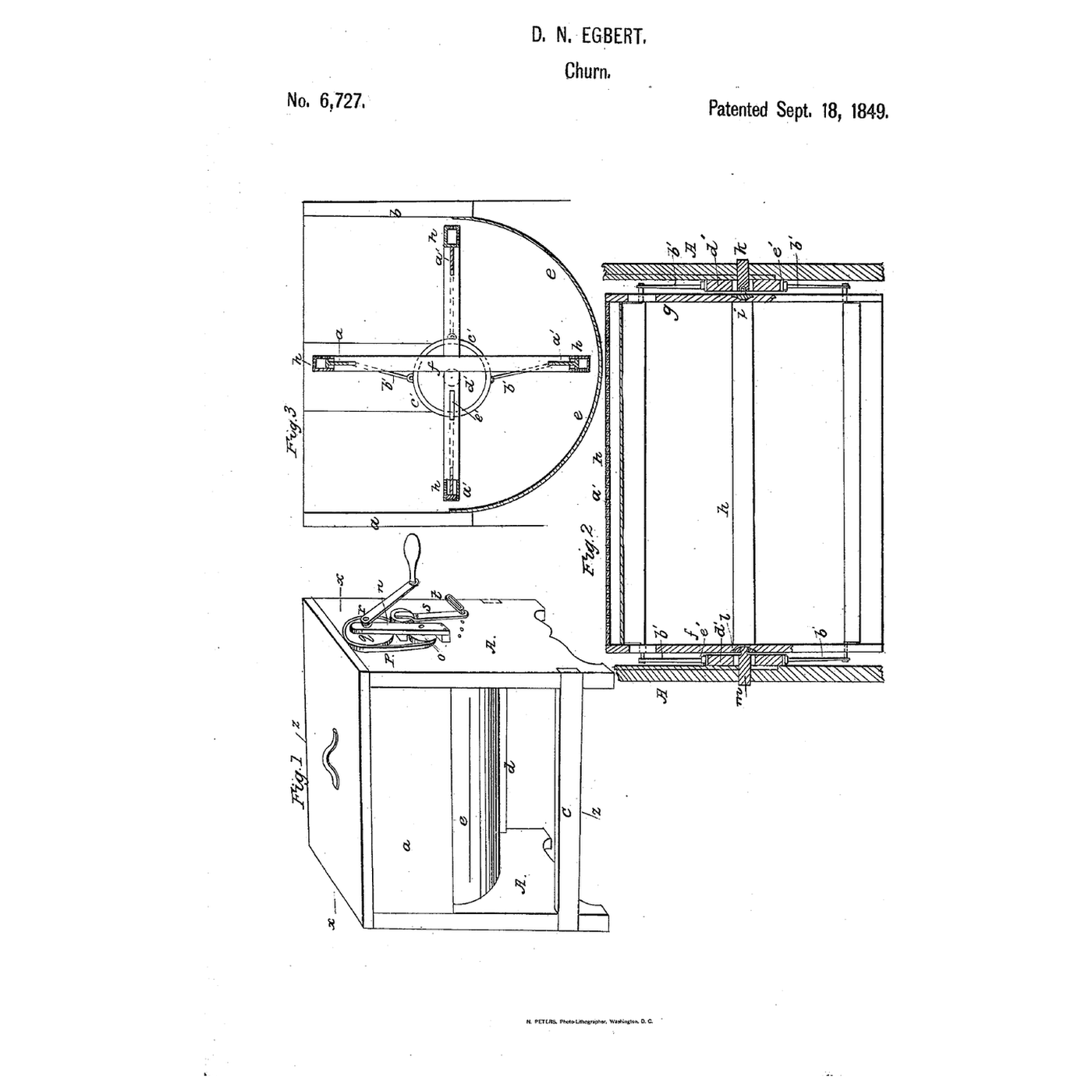
Egbert wanted the air "forcibly discharged in small jets at the very point where it is most required, viz, the moving surface of the dasher." D. N. Egbert of Hudson, Ohio, received US 6,727, dated 18 September 1849, for a rotary churn-dasher in a case with a zinc bottom: two sets of arms joined by hollow floats whose sides are pierced with small holes, each fitted with a piston. Connecting rods join the pistons to an eccentric ring running on an eccentric fixed to the end piece, so each float fills with air as it ascends and discharges it as it descends. A strap from a large pulley on the crank shaft to a small one on the dasher's shaft turns it fast. This rung works out the air each float pumps, then prints the floats, pistons, eccentric and arms, builds them over a stainless bottom, and makes butter.
Avanzato
About 6 hours, plus printing

Istruzioni

1

Air per float

Caricamento del notebook Jupyter…
2

A dasher that is also an air pump before it

The embedded blueprint pumps air with a tube over a loose plunger. Egbert builds the pump into each float of a rotary dasher.
3

Read US 6,727

"It will now be perceived that as the floats ascend above their horizontal position by the revolution of the dasher, each piston is in turn withdrawn in its appropriate float and the hollow cavity filled with air; as the floats descend below their horizontal position this air is forcibly discharged through the perforations of the floats, below the surface of the liquid."
4

Print the parts

Print two hollow floats (/uploads/blueprints/piston-float-air-churn-hollow-float.stl) and two pistons (/uploads/blueprints/piston-float-air-churn-piston.stl), the fixed eccentric (/uploads/blueprints/piston-float-air-churn-eccentric.stl) and its ring (/uploads/blueprints/piston-float-air-churn-eccentric-ring.stl), two arm sets (/uploads/blueprints/piston-float-air-churn-arms.stl) and the crank arm (/uploads/blueprints/piston-float-air-churn-crank-arm.stl). Print in PETG at 0.2 mm layers, 30 % infill, 4 walls; wash before first use.

Materiali per questo passaggio:

Filamento PETGFilamento PETG1 pezzo

Strumenti necessari:

Stampante 3D a filamento (FDM)Stampante 3D a filamento (FDM)
5

The case

Make two plywood end pieces with a 90 mm radius half circle grooved in each, and bend a 0.5 mm stainless sheet into the bottom, seated in the grooves with silicone, as his zinc bottom. Screw the eccentric to the inside of one end on the axis, offset upward as printed.

Materiali per questo passaggio:

Pannello di compensatoPannello di compensato1 pezzo
Lamiera di acciaio inossidabile - 304Lamiera di acciaio inossidabile - 3041 pezzo

Sigillante siliconicoSigillante siliconico1 pezzo
Vite da legno #8 x 1"Vite da legno #8 x 1"1 pezzo

Strumenti necessari:

Sega da traforoSega da traforo
Cesoie da lattoniereCesoie da lattoniere
SbavatoreSbavatore
Mazzuolo di gommaMazzuolo di gomma
Set di cacciavitiSet di cacciaviti
6

Dasher, pistons and rods

Slide the two arm sets onto a 10 mm square hardwood shaft and screw a float to the ends of each pair of arms, holes outward. Fit a piston in each float. Fit the ring over the eccentric and join each piston to the ring with two thin pine rods on M3 screws, so the ring is carried round by the arms. Pass the shaft through the other end and glue the crank arm and handle on.

Materiali per questo passaggio:

Tasselli di legno duroTasselli di legno duro1 pezzo
Tavola di pinoTavola di pino1 pezzo
Viti da metalloViti da metallo1 pezzo
Dado esagonaleDado esagonale1 pezzo
Colla da legnoColla da legno1 pezzo

Strumenti necessari:

Sega a manoSega a mano
Trapano a batteriaTrapano a batteria
Serie di punte da trapanoSerie di punte da trapano
Set di cacciavitiSet di cacciaviti
7

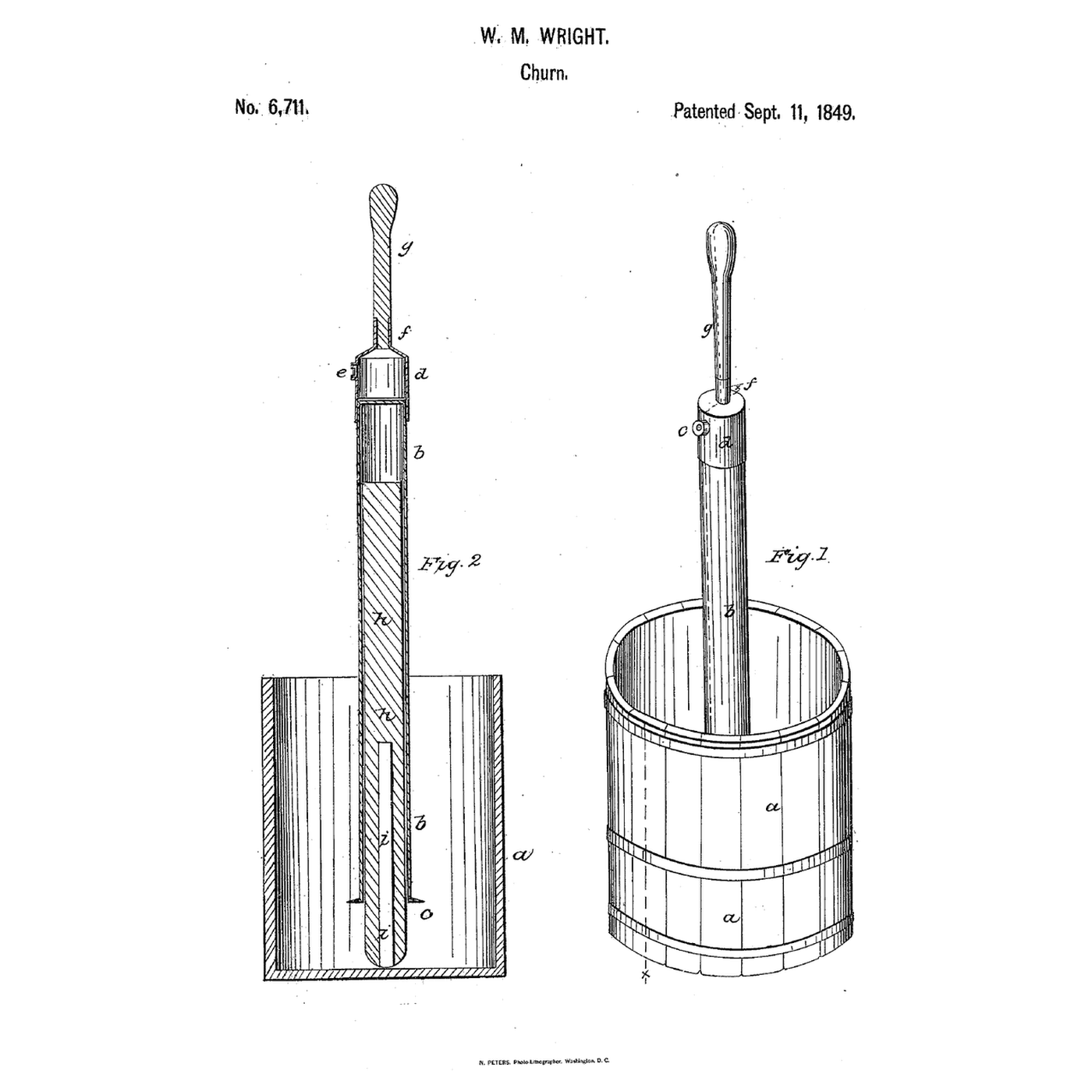
The patent drawing

US 6,727 drawing sheet, public domain (expired patent).
Passo 7 - Image 1
8

Crank and make butter

Let the heavy cream stand until it reaches about 15 °C, checked with the thermometer. Pour in 1.5 litres. Crank steadily and watch for jets of bubbles as each float goes down; time until the butter comes. Pour off the buttermilk, add cold water, churn a little and pour off again until it runs clear; work in a pinch of salt and weigh the butter.

Materiali per questo passaggio:

Panna da montarePanna da montare1500 ml
Sale marino grossoSale marino grosso1 pezzo
AcquaAcqua1 pezzo

Strumenti necessari:

Termometro a sonda permanenteTermometro a sonda permanente
CronometroCronometro
Bilancia digitale da cucinaBilancia digitale da cucina
Grande ciotola da impasto in acciaio inossidabileGrande ciotola da impasto in acciaio inossidabile
9

Pistons that stick, no jets

Piston-float air churn troubleshooting.

Flow

Loading...
10

History and honest limits

**D. N. Egbert** of Hudson, Summit County, Ohio, received US 6,727, dated 18 September 1849. A tightening pulley on a spring lever kept the strap taut. He claimed the combination of the pistons moved by stationary eccentrics with the floats of a revolving dasher. **Honest limits.** Our crank turns the shaft directly, without his strap and pulleys; stainless sheet and printed parts stand in for his zinc and wooden floats. The notebook gives an upper bound. FDM prints hold food in their layer lines, so wash well and replace when worn. Your times and weights are the result.

Materiali

13

Strumenti richiesti

13

Questo progetto realizza

CC0 Pubblico dominio

Questo progetto è rilasciato sotto CC0. Sei libero di copiare, modificare, distribuire e utilizzare quest'opera per qualsiasi scopo, senza chiedere permesso.

Supporta il Maker acquistando prodotti tramite il suo progetto dove guadagna una Commissione Maker stabilita dai venditori, oppure crea una nuova iterazione di questo progetto e includilo come collegamento nel tuo progetto per condividere i ricavi.

Commenti

(0)

Accedi per partecipare alla discussione

Caricamento commenti...