アート
美容とウェルネス
工芸
文化と歴史
エンターテインメント
環境
食品と飲料
リバースエンジニアリング
科学
スポーツ
テクノロジー
ウェアラブル
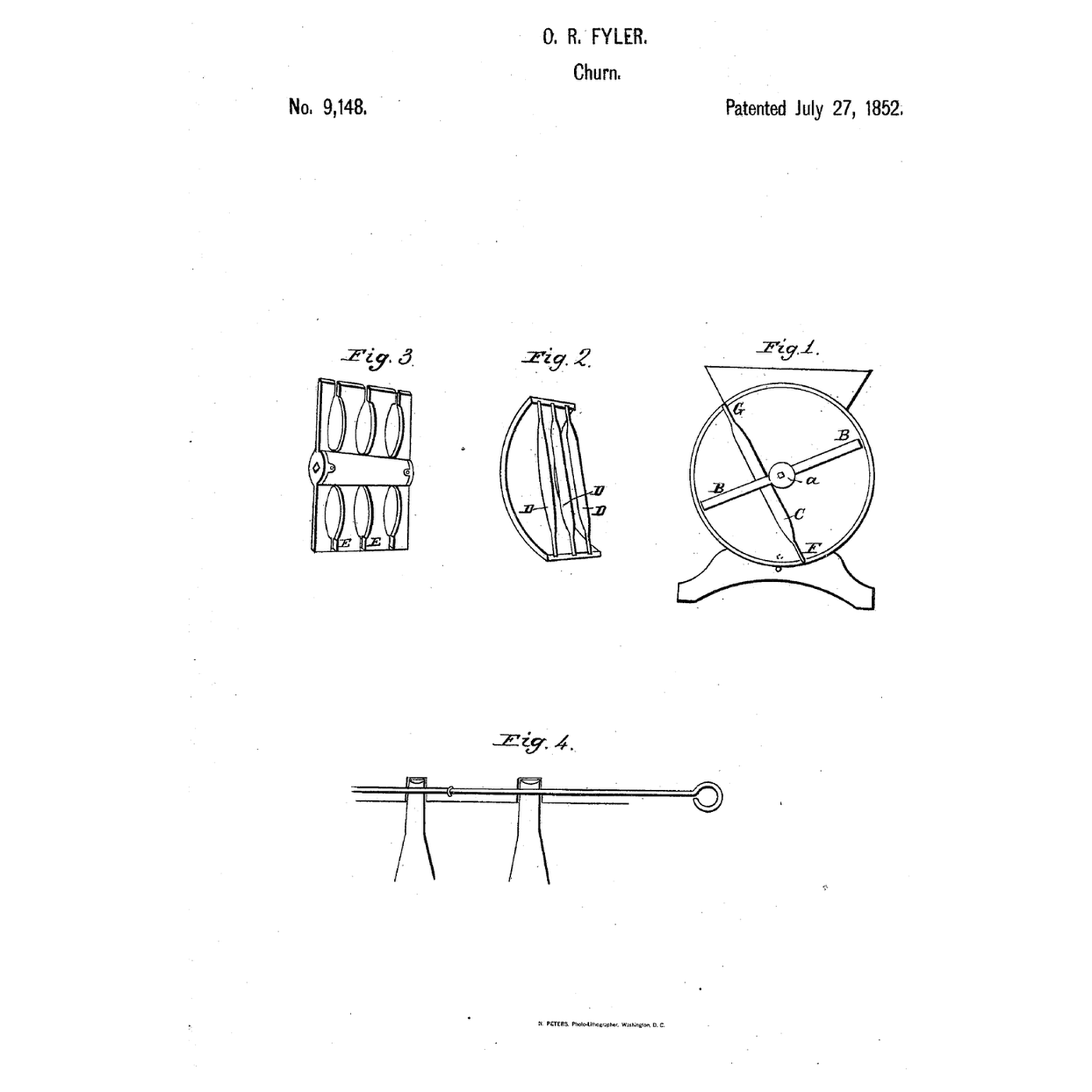


Post-and-Float Butter-Working Churn: Floats Revolving Astride Fixed Posts
Fyler built one machine to churn the cream and then work the butter, which he called the "Butter-Working Churn."
Orsamus R. Fyler of Brattleboro, Vermont, received US 9,148, dated 27 July 1852, for a cylinder churn whose floats, fixed to a shaft turned by a crank, "go astride of C the posts which stand firmly in the periphery of the churn and have their place as near as practicable to the axis." The posts are "large in their middle portions ... and small at each end"; the floats are "broad at their ends ... and narrow at the portion near the shaft," leaving oval passages. The posts lift out through the door; a slide lengthens the crank for the stiffer butter.
This rung looks at the crank's leverage, then prints the floats and posts, builds the drum, and makes and works butter.
中級者
About 4 hours, plus printing
手順
1
1
The longer crank
The longer crank
Jupyter ノートブックを読み込み中…
2
2
Churning and working in one churn before it
Churning and working in one churn before it
The embedded blueprint presses the butter between rollers and the churn's side. Fyler works it by drawing the floats through it past fixed posts.
3
3
Read US 9,148
Read US 9,148
"This smallness of the posts at each extremity enables them to pass through the butter with less resistance; and this wideness of the floats near the periphery and narrowness near the shaft makes them more efficient in moving and agitating the cream; in carrying more air into the cream; in reclosing the holes which the posts have cut in the butter; and in forcing the butter to pass through nearer the axis when the purchase upon it is greater."
4
4
Print the parts
Print the parts
Print two floats with their oval windows and square hubs, two spindle-shaped posts and the crank arm. Print in PETG at 0.2 mm layers, 30 % infill, 4 walls; wash before first use.
このステップの材料:
 PETGフィラメント1 個
必要な工具:
 FDM 3D プリンター
5
5
Print the float
7
7
Print the crank arm
8
8
The drum
The drum
Use a round food-grade container about 180 mm across, laid on its side on a pine stand, with a door cut in its upper side. Drill holes in its lower side under the axis, 80 mm apart, and matching holes in the door, so the posts stand across the drum just beside the axis; a stainless skewer through holes above the door holds them.
このステップの材料:
 食品級の保存容器1 個
 松板1 個
 軟鋼丸棒1 個
 #8 × 1 インチ木ねじ1 個
必要な工具:
 糸のこ(コーピングソー)
 コードレスドリル
 ドリルビットセット
 手のこぎり
9
9
Shaft, floats and crank
Shaft, floats and crank
Pass a 10 mm square hardwood shaft through the drum's ends and the two floats, set opposite each other so their windows pass the posts. Glue on the crank arm and a dowel handle; a second hole further out lengthens the crank for working the butter.
このステップの材料:
 堅木のダボ1 個
 木工用接着剤1 個
 革の細帯1 個
必要な工具:
手のこぎり 紙やすり
10
10
The build in 3D
The build in 3D
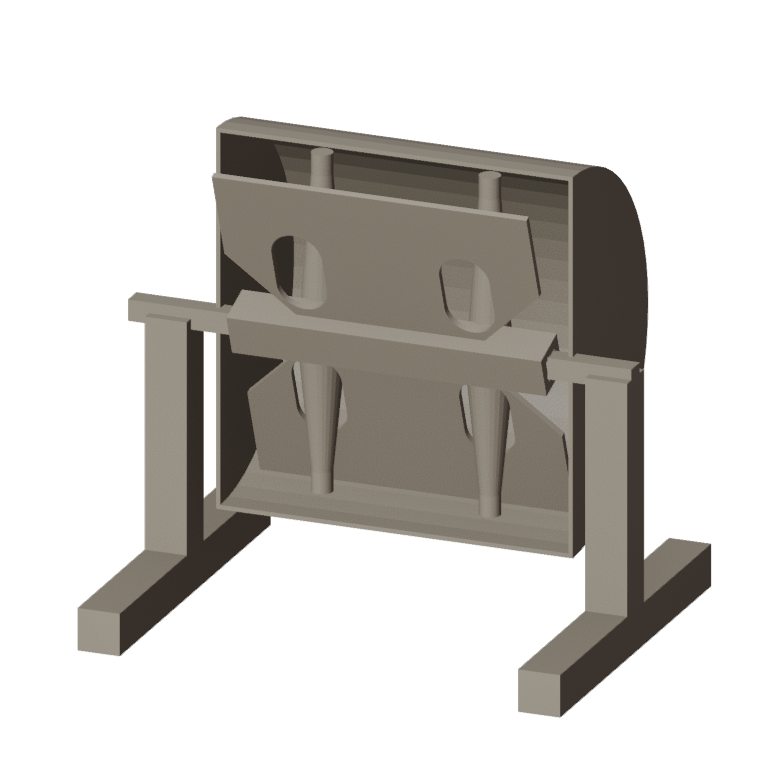
FreeCAD model of this build, not of the patent: the drum cut away to show the two spindle-shaped posts standing across it beside the axis, and the floats with oval windows going astride them, on the stand.
11
11
Churn, then work the butter
Churn, then work the butter
Let the heavy cream stand until it reaches about 15 °C, checked with the thermometer. Pour in 1.5 litres and close the door. Crank steadily; time until the butter comes. Draw off the buttermilk, add cold water and crank on with the long crank hole, so the floats draw the butter past the posts and work it, until the water runs clear. Work in a pinch of salt the same way and weigh the butter.
このステップの材料:
 生クリーム1500 ml
 粗い海塩1 個
 水1 個
必要な工具:
 差しっぱなしのプローブ温度計
 ストップウォッチ
 デジタルキッチンスケール
 ステンレス鋼の大きな混ぜ鉢
12
12
Floats that catch the posts, a door that lifts
Floats that catch the posts, a door that lifts
Post-and-float churn troubleshooting.
Flow
Loading...
13
13
History and honest limits
History and honest limits
**Orsamus R. Fyler** of Brattleboro, Windham County, Vermont, received US 9,148, dated 27 July 1852 (the drawing sheet reads "O. R. Fyler"). He claimed the combination of floats on a revolving axis with stationary posts near the axis, and of dashers broad at their ends with posts small at each end and large in their middle.
**Honest limits.** A food-grade container and printed parts stand in for his cylinder; the notebook's loads are illustrative, not measured. FDM prints hold food in their layer lines, so wash well and replace when worn. Your times and weights are the result.
材料
11- 1 個プレースホルダー
- 1 個プレースホルダー
- 1 個プレースホルダー
- 1 個プレースホルダー
- プレースホルダー
- 1 個プレースホルダー
- 1 個プレースホルダー
- 1 個プレースホルダー
- 1500 mlプレースホルダー
- 1 個プレースホルダー
- 1 個プレースホルダー
必要な工具
10- プレースホルダー
- プレースホルダー
- 1 vendor sell this, none ship to you yetプレースホルダー
- プレースホルダー
- プレースホルダー
- プレースホルダー
- プレースホルダー
- プレースホルダー
- プレースホルダー
- プレースホルダー
設計ファイル
4この設計図で作るもの
関連ブループリント
これらのブループリントは知識を共有しています — 技術、材料、原理

CC0 パブリックドメイン
このブループリントはCC0で公開されています。許可を求めずに、自由にコピー、修正、配布、あらゆる目的で使用できます。
メイカーを応援するには、ブループリント経由で製品を購入してください。メイカーには メイカーコミッション がベンダーにより設定されています。または、このブループリントの新しいイテレーションを作成し、自分のブループリントにコネクションとして含めて収益を共有できます。