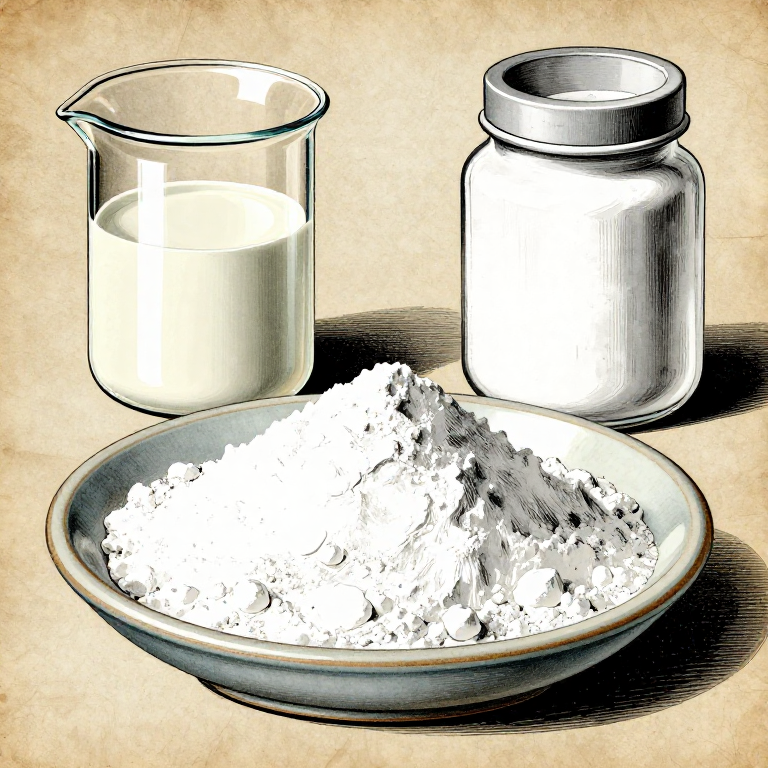

Making Titanium White — The Pigment That Ended Two Millennia of Lead White
Titanium White (titanium dioxide, TiO₂, PW6) is the most important white pigment of the modern era — and the most widely produced pigment of any colour in history. First manufactured commercially in 1921 in both Norway (by Titan Co.) and the United States (by National Lead Company), it rapidly displaced the two white pigments that had dominated painting for millennia: Lead White (toxic, darkens with sulfur gases) and Zinc White (weak tinting strength, brittle in oil).
Titanium dioxide has the highest refractive index of any common white pigment (n = 2.73 for rutile), giving it extraordinary opacity and brightness. A single coat of titanium white paint covers surfaces that would need three coats of zinc white. It is non-toxic, chemically inert, lightfast, and stable in all media.
The synthesis follows the sulfate process, the original industrial route: ilmenite ore (FeTiO₃) is digested in hot concentrated sulfuric acid, dissolving both iron and titanium into solution. The iron is crystallised out as ferrous sulfate, and the remaining titanyl sulfate is hydrolysed with heat and dilution to precipitate hydrated titanium dioxide. This white gel is washed, dried, and calcined at 900 °C to produce the final anatase-phase pigment powder.
SAFETY WARNING: This process uses concentrated sulfuric acid (96%), which causes severe chemical burns on contact and generates extreme heat when mixed with water or minerals. The acid digestion step is violently exothermic. Work OUTDOORS with a P100 respirator, full-face splash goggles, acid-resistant gloves, and a heavy lab coat or apron. Keep large volumes of water nearby for emergency flushing. Never add water to acid — always add acid to water, and in this process, add solid ilmenite to acid slowly, grain by grain.
안내
Don full acid-resistant protective equipment
This process involves concentrated sulfuric acid — one of the most dangerous laboratory reagents. Before opening any container, put on a P100 respirator, full-face chemical splash goggles, thick nitrile inner gloves under leather gauntlet gloves (acid will destroy leather over time, but the leather protects against splashes), and a full lab coat. Set up your workspace OUTDOORS on a fireproof surface (concrete or bare earth) with a large bucket of clean water within arm's reach for emergency skin flushing.
필요한 도구:
P100/FFP3 Respirator with Acid Gas Cartridge
Lab Safety Goggles (Chemical Splash)
Leather Gauntlet Gloves
Nitrile Rubber Gloves (Thick)
Lab CoatWeigh and grind ilmenite sand
Weigh and grind ilmenite sand
Weigh out 30 g of ilmenite sand — a heavy, black, iron-titanium oxide mineral (FeTiO₃) found in beach sands and alluvial deposits worldwide. Grind the sand to a fine powder in a mortar — the finer the grind, the more surface area exposed to the acid and the more complete the digestion. The powder should feel smooth, not gritty, between your fingers.
이 단계의 재료:
Ilmenite Sand (ground)30 g필요한 도구:
Mortar and Pestle (Porcelain)Measure concentrated sulfuric acid
Measure concentrated sulfuric acid
Carefully measure 80 ml of concentrated sulfuric acid (96% H₂SO₄) — a dense, oily, colourless liquid that is one of the strongest mineral acids. Pour slowly from the stock bottle into a dry graduated cylinder. Never pipette by mouth. Sulfuric acid is intensely hygroscopic and generates extreme heat on contact with water — any splash on skin must be flushed immediately with copious running water for at least 15 minutes.
이 단계의 재료:
Sulfuric Acid (96% concentrated)80 mlHeat sulfuric acid in borosilicate beaker
Heat sulfuric acid in borosilicate beaker
Pour the 80 ml of concentrated sulfuric acid into a 1-litre heat-resistant borosilicate glass beaker. Place the beaker on a hot plate outdoors and heat slowly to 150 °C. The acid will begin to fume slightly — thin white wisps of sulfur trioxide. Do not overheat past 200 °C at this stage. Position yourself upwind at all times.
필요한 도구:
Heat-Resistant Glass Beaker (1 liter)
Hot Plate (Laboratory/Kitchen)Add ilmenite to hot acid — grain by grain
Add ilmenite to hot acid — grain by grain
This is the most dangerous step. Using a small metal spatula, add the ground ilmenite to the hot sulfuric acid ONE SMALL SPATULA-TIP AT A TIME. Each addition causes a vigorous exothermic reaction — the temperature spikes, the mixture darkens and may splutter. Wait 30 seconds between additions. The mixture will gradually turn dark purple-black as iron and titanium dissolve into the acid. NEVER dump all the ilmenite in at once — the violent boiling could eject hot acid from the beaker.
Digest at 200 °C for two hours
Once all ilmenite has been added, raise the hot plate temperature to maintain the mixture at 200 °C. Stir occasionally with a glass rod (metal will corrode). The mixture will thicken into a dense, dark purple-black paste as the sulfuric acid attacks the titanium-iron oxide crystal structure. After two hours, the paste should be uniformly dark with no visible unreacted black grains. Dense white SO₃ fumes will evolve — stay upwind.
필요한 도구:
Glass Stirring Rod (25cm)Cool digest cake to room temperature
Cool digest cake to room temperature
Turn off the hot plate and allow the thick acid-digest paste to cool completely to room temperature — this takes 2–3 hours. Do not rush cooling with water: adding water to hot concentrated acid causes explosive steam generation. The cooled cake will be a hard, dark purple-black solid that cracks when tapped.
Dissolve digest cake in cold water
Slowly add 500 ml of cold distilled water to the cooled digest cake in small portions, stirring continuously. Always add WATER TO THE ACID CAKE, not the other way — each addition will generate heat. The dark cake will gradually dissolve into a murky, dark green-black solution containing titanyl sulfate (TiOSO₄) and ferrous sulfate (FeSO₄). Stir until no undissolved lumps remain.
이 단계의 재료:
Distilled Water (1 Liter)500 mlFilter to remove undissolved residue
Filter to remove undissolved residue
Set up a glass funnel with filter paper and pour the dark solution through it into a clean beaker. The filter will catch undissolved silica, unattacked ilmenite, and other gangue minerals as a dark gritty residue. The filtrate — a dark green to brown-green acidic solution — contains the dissolved titanium and iron. This filtrate is your working solution.
필요한 도구:
Glass Funnel (Stemmed)
Filter Paper (fine pore)
Glass Beaker (Borosilicate, 500ml)Crystallise out iron sulfate
Crystallise out iron sulfate
Cool the filtered solution in an ice bath or cold water for 2–3 hours. Green crystals of ferrous sulfate heptahydrate (FeSO₄·7H₂O, also called copperas or green vitriol) will form as the solution temperature drops below 20 °C. These crystals are the iron removed from the ilmenite — they must be separated to leave a solution enriched in titanium. Ferrous sulfate is mildly toxic; handle with gloves.
Separate iron crystals from titanium solution
Filter or carefully decant the cold solution away from the green iron sulfate crystals. The remaining solution should be lighter in colour — yellow-green to amber — indicating that most of the iron has been removed. Set the iron crystals aside (they have historical uses as ink ingredient and mordant). The filtrate is now predominantly titanyl sulfate in dilute sulfuric acid.
필요한 도구:
Filter Paper (fine pore)Dilute and heat to hydrolyse titanyl sulfate
Dilute and heat to hydrolyse titanyl sulfate
Add 200 ml more distilled water to the titanium-enriched solution and heat on the hot plate to 95 °C. As the dilute acidic solution heats, the titanyl sulfate hydrolyses — titanium ions react with water to form insoluble hydrated titanium dioxide (TiO₂·xH₂O), which precipitates as a fine white gel. The solution will turn milky white and thicken. Hold at 95 °C for one hour, stirring occasionally.
이 단계의 재료:
Distilled Water (1 Liter)200 mlFilter precipitated titanium dioxide
Filter precipitated titanium dioxide
Allow the white suspension to cool slightly, then filter through fine filter paper. The white gel-like precipitate on the filter is crude hydrated titanium dioxide — the precursor to your finished pigment. The filtrate is dilute sulfuric acid waste — collect it for proper disposal. The precipitate will be slow to filter because of its gel-like consistency; patience is required.
필요한 도구:
Glass Funnel (Stemmed)
Filter Paper (fine pore)Wash precipitate to remove all sulfate
Wash precipitate to remove all sulfate
Wash the filter cake three times with 200 ml portions of hot distilled water, pouring through the filter each time and allowing to drain fully. Residual sulfate will cause the finished pigment to turn yellow or develop a gritty texture. Continue washing until the filtrate is neutral (test with pH paper). This is the most tedious but most important purification step.
이 단계의 재료:
Distilled Water (1 Liter)600 mlDry washed precipitate
Dry washed precipitate
Spread the washed white gel on a clean glass plate or ceramic tile in a thin layer. Dry in a warm, dust-free location for 24–48 hours. The gel will shrink and crack as it dries, forming white flakes and chunks. The dried material is amorphous hydrated TiO₂ — it must still be calcined to develop the crystalline anatase structure that gives titanium white its exceptional opacity.
Pack dried precipitate into crucible
Crumble the dried TiO₂ flakes and pack them into a refractory clay crucible. Press down firmly — the material will shrink further during calcination. Fill no more than two-thirds. Place a loose lid on top. The crucible does not need sealing (unlike cadmium or selenium processes) because TiO₂ does not volatilise at these temperatures.
필요한 도구:
Clay Crucible (refractory)Calcine at 900 °C for two hours
Calcine at 900 °C for two hours
Place the crucible in a charcoal furnace and fire to 900 °C. At this temperature, the amorphous hydrated TiO₂ crystallises into the anatase phase — the crystal structure that gives titanium white its characteristic brilliant white colour and extraordinary refractive index. Hold at temperature for two hours, adding charcoal as needed. The calcined material will glow dull orange through the crucible walls.
이 단계의 재료:
Charcoal5 kg필요한 도구:
Charcoal Furnace (small)
Crucible Tongs (long-handled)Cool and remove calcined product
Cool and remove calcined product
Allow the furnace to cool completely (overnight is safest). Remove the crucible using tongs. The calcined product should be a hard, dense, brilliant white sintered mass — noticeably whiter and more opaque than the pre-calcined dried gel. If it has a yellowish tint, trace iron was not fully removed during crystallisation; the pigment is still usable but lower grade.
Grind calcined mass in mortar
Break the sintered white mass out of the crucible and grind in a porcelain mortar to a coarse powder. The material will be hard but brittle. Wear a dust mask — while titanium dioxide is non-toxic as a bulk pigment, any fine mineral dust should not be inhaled in quantity. Grind until no large lumps remain.
필요한 도구:
Dust Mask
Mortar and Pestle (Porcelain)Final mulling with glass muller
Final mulling with glass muller
Transfer the coarse powder to a flat stone slab and mull with a glass muller, adding drops of distilled water to form a paste. Mull with firm circular strokes for fifteen minutes. Titanium dioxide particles must be reduced to sub-micron size to achieve maximum opacity — the refractive index advantage only manifests at very fine particle sizes. The paste should feel perfectly smooth with zero grit.
이 단계의 재료:
Distilled Water (1 Liter)10 ml필요한 도구:
Glass Muller
Flat Stone SlabSieve through 120-mesh
Sieve through 120-mesh
Dry the mulled paste fully, then pass through a 120-mesh sieve. The sieved powder is the finished titanium white pigment — a fine, dense, brilliantly white powder with the highest opacity of any white pigment known. It will feel heavier than zinc white or chalk white for a given volume due to its high density (4.23 g/cm³ for anatase).
필요한 도구:
120-Mesh SieveStore finished titanium white pigment
Store finished titanium white pigment
Transfer the sieved pigment to a clean, dry glass storage jar with a tight-fitting lid. Label with the pigment name (Titanium White, PW6, anatase phase), date, and batch weight. Store in a cool, dry place. Titanium dioxide is among the most stable pigments ever produced — it does not yellow, darken, or degrade under any conditions encountered in normal use. Expected yield from this batch: approximately 8–12 g of finished pigment. Dispose of all acid waste, filter papers, and iron sulfate crystals responsibly according to local hazardous waste regulations.
필요한 도구:
Glass Storage Jar with Lid재료
4- 플레이스홀더
- 80 ml플레이스홀더
- 1310 ml플레이스홀더
필요 도구
20- 플레이스홀더
- 플레이스홀더
- 플레이스홀더
- 플레이스홀더
- 플레이스홀더
연결된 블루프린트 재료
관련 블루프린트
이 블루프린트들은 지식을 공유합니다 — 기술, 재료 또는 원리
Related blueprints
Other builds that share materials, tools, or techniques with this one.


CC0 퍼블릭 도메인
이 블루프린트는 CC0로 공개되었습니다. 어떤 목적으로든 자유롭게 복사, 수정, 배포 및 사용할 수 있습니다.
제품 구매를 통해 메이커를 지원하세요. 판매자가 설정한 메이커 커미션 을 받거나, 이 블루프린트의 새로운 반복을 만들어 연결로 포함시킬 수 있습니다.