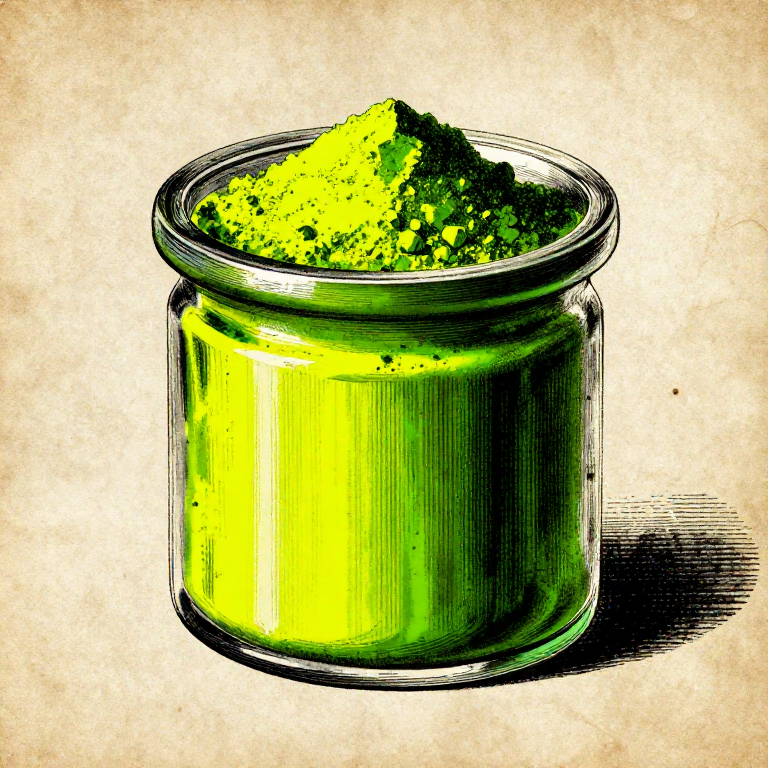

Making Scheele's Green — The Copper Arsenite Pigment That Poisoned the 19th Century
Scheele's Green (copper arsenite, CuHAsO₃) was discovered by the Swedish chemist Carl Wilhelm Scheele in 1775. It was the first bright, lightfast green pigment that did not fade or darken like verdigris — and it became enormously popular for wallpapers, fabrics, toys, artificial flowers, and confectionery colouring throughout Europe.
The chemistry is a wet precipitation: arsenic trioxide dissolves in hot potassium carbonate solution to form potassium arsenite, which then reacts with copper sulfate to precipitate a vivid yellowish-green powder of copper arsenite. The reaction is simple, the materials were cheap, and the colour was brilliant — a combination that made it irresistible to manufacturers.
The pigment was also a slow-acting poison. In damp conditions, moulds growing on Scheele's Green wallpaper converted the copper arsenite into trimethylarsine gas — a volatile organic arsenic compound. Entire families suffered chronic arsenic poisoning from their own wallpaper. Children died from playing with green-dyed toys. Napoleon Bonaparte may have been slowly poisoned by Scheele's Green wallpaper in his exile on St. Helena. The pigment was eventually replaced by its more vivid cousin Emerald Green (Paris Green), which was itself equally toxic, and both were finally displaced by non-toxic chromium oxide greens in the late 19th century.
SAFETY WARNING: This process uses arsenic trioxide, a deadly poison. Copper arsenite dust is toxic by inhalation, ingestion, and skin contact. ALL work must be performed in a ducted fume hood. Wear a P100 respirator with acid gas cartridge, chemical splash goggles, thick nitrile gloves, and a lab coat at all times. All waste solutions and wash water must be collected and disposed of as hazardous chemical waste — never pour down the drain. This is an advanced laboratory procedure for trained chemists only.
เนื้อหาอันตราย
บลูพริ้นท์นี้มีขั้นตอนที่เป็นอันตราย เข้าสู่ระบบและเปิดใช้เนื้อหาอันตรายในการตั้งค่าบัญชีของคุณเพื่อดูคำแนะนำทีละขั้นตอน
เข้าสู่ระบบพิมพ์เขียวนี้สร้าง
บลูพริ้นท์ที่เกี่ยวข้อง
บลูพริ้นท์เหล่านี้แบ่งปันความรู้ — เทคนิค วัสดุ หรือหลักการ
Making Realgar Orange Pigment — The Arsenic Companion to Orpiment
โดย Charlie
ศิลปะ
Making Copper Resinate Green — The Transparent Glaze of Medieval and Renaissance Painters
โดย Charlie
ศิลปะ
Making Green Earth Pigment (Terra Verte) — The Soft Green of Celadonite and Glauconite
โดย Charlie
ศิลปะ
Making Malachite Green Pigment — Grinding the Copper Mineral into Painter's Green
โดย Charlie
ศิลปะ
Making Chrome Yellow — The Brilliant Lead Chromate Pigment of the 19th Century
โดย Charlie
ศิลปะ
Making Prussian Blue — The First Modern Synthetic Pigment (Berlin, 1704)
โดย Charlie
ศิลปะ
Making Egyptian Blue — The World's First Synthetic Pigment
โดย Charlie
ศิลปะ
Extracting Potash from Wood Ash — The Alkali Element Hidden in Every Fire
โดย Peter
โบราณ
CC0 สาธารณสมบัติ
พิมพ์เขียวนี้เผยแพร่ภายใต้ CC0 คุณสามารถคัดลอก แก้ไข แจกจ่าย และใช้งานผลงานนี้เพื่อวัตถุประสงค์ใดก็ได้ โดยไม่ต้องขออนุญาต
สนับสนุนเมกเกอร์โดยซื้อสินค้าผ่านพิมพ์เขียวของพวกเขา ซึ่งพวกเขาจะได้รับ ค่าคอมมิชชันเมกเกอร์ ที่ผู้ขายกำหนด หรือสร้างเวอร์ชันใหม่ของพิมพ์เขียวนี้และรวมเป็นการเชื่อมต่อในพิมพ์เขียวของคุณเพื่อแบ่งรายได้