ศิลปะ
ความงามและสุขภาพ
งานฝีมือ
วัฒนธรรมและประวัติศาสตร์
ความบันเทิง
สิ่งแวดล้อม
อาหารและเครื่องดื่ม
วิศวกรรมย้อนรอย
วิทยาศาสตร์
กีฬา
เทคโนโลยี
อุปกรณ์สวมใส่
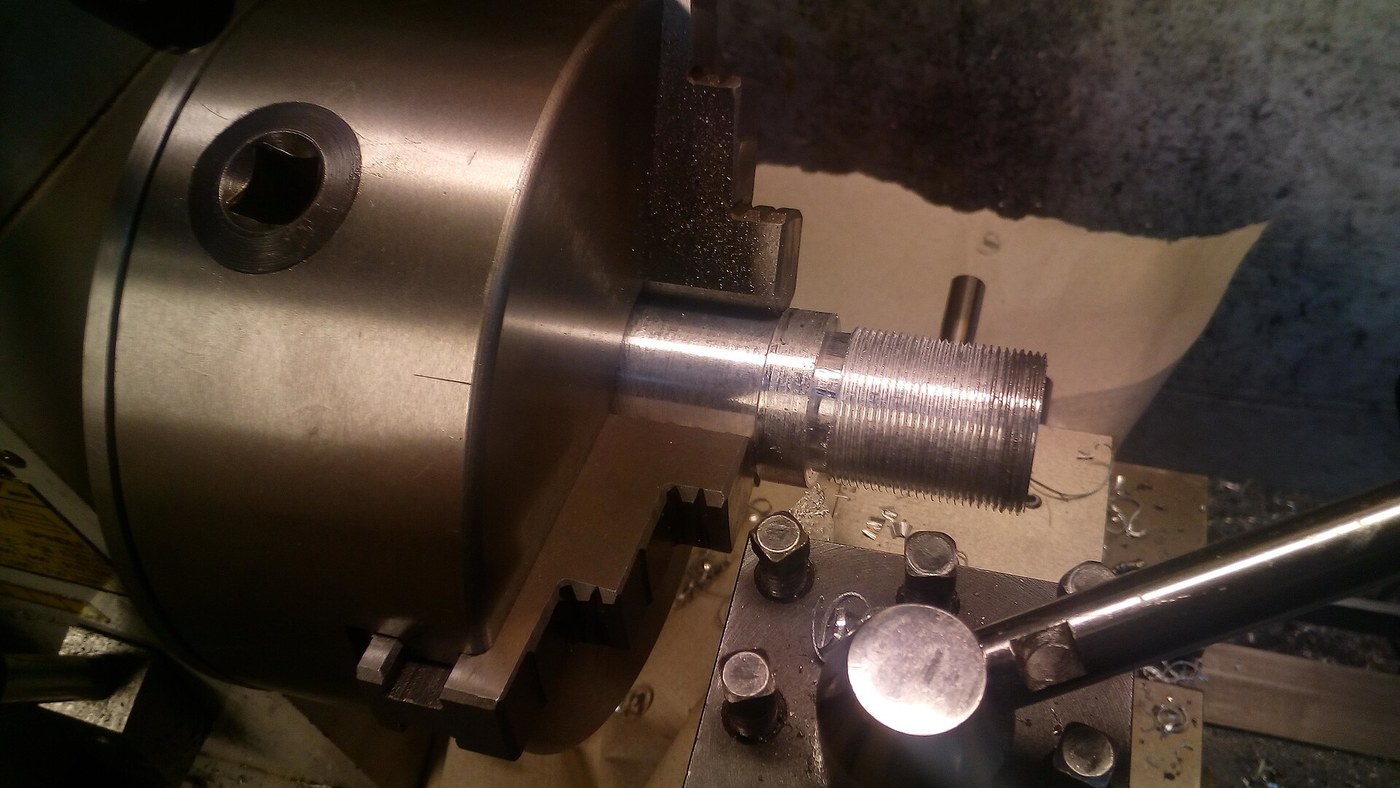


Single-Point Screw Cutting: Making a Thread the Lathe Has Never Seen
A tap and die cut the threads somebody else decided to make. Single-point screw cutting makes any thread at all — a worn imperial size nobody stocks, an oversize repair thread, a left-hand lead screw, a square thread for a vice — from a bar and a ground tool.
The idea is simple and the consequence is enormous. Couple the carriage to the spindle through gears so that the tool advances a fixed distance per revolution, and the tool traces a helix. Choose the gear ratio and you have chosen the pitch.
This is the operation that makes a lathe a machine TOOL rather than a machine: it can produce the lead screws that other lathes are built from, which is why the screw-cutting lathe published here is described as the machine that makes other machines.
ขั้นสูง
5 hours
คำแนะนำ
1
1
Turn the blank, and leave the crest short
Turn the blank, and leave the crest short
Turn the outside diameter to the thread's major diameter, and chamfer the leading end at about 45 degrees down past the thread depth.
Turn it a few hundredths UNDER nominal rather than exactly on. A single-point tool with a sharp point leaves no crest flat, and a thread cut to the full nominal diameter finishes with a thin feather-edged crest that tears and does not gauge properly. The standard form has a flat on the crest, and turning slightly undersize produces it for free.
The chamfer matters for the same practical reason a bolt has one: it starts the nut, and it stops the first thread being a fragile knife-edge that gets knocked off in a drawer.
วัสดุสำหรับขั้นตอนนี้:
 เหล็กเส้นกลมเหล็กกล้าละมุน1 ชิ้น
เครื่องมือที่ต้องใช้:
 เครื่องกลึงโลหะ
 ชุดเครื่องมือกลึง (HSS)
 ไมโครมิเตอร์
2
2
Set the gears, the tool and the compound
Set the gears, the tool and the compound
Set the change gears or the gearbox for the pitch you want, grind or fit a 60 degree tool for a metric or unified thread, and set it SQUARE to the work with a thread gauge against the turned diameter.
A tool set even a degree out of square cuts a thread with unequal flank angles that will not fit a standard nut properly, and no amount of careful infeed fixes it afterwards.
Swing the compound slide to 29.5 degrees from the cross-slide direction and feed in with the COMPOUND rather than straight in. At that angle almost all the cutting is done by the leading flank alone, with the trailing flank just skimming — one edge cutting instead of three, which means less force, less chatter and a far better finish.
เครื่องมือที่ต้องใช้:
เครื่องกลึงโลหะชุดเครื่องมือกลึง (HSS) เกจวัดเกลียว
3
3
Pitch, depth and how many passes
Pitch, depth and how many passes
กำลังโหลดสมุด Jupyter…
เครื่องมือที่ต้องใช้:
เครื่องกลึงโลหะ เครื่องคิดเลข
4
4
The first pass is a scratch, and you check it
The first pass is a scratch, and you check it
Take a first pass so light it barely marks the work, then stop and measure the pitch of the scratch with a rule over ten threads, or with a thread gauge.
If the gears are wrong you have lost nothing. If you had gone straight to depth you would have cut a full thread of entirely the wrong pitch, and the blank is scrap. Ten threads measured over their length divides the reading error by ten, which is what makes a steel rule adequate for the check.
Withdraw the tool at the END of every pass before reversing, and return to the same starting point each time. On a metric thread cut with a metric lead screw you can usually use the thread dial; where the pitches are not related, keep the half-nuts engaged and reverse the spindle instead, because disengaging loses the relationship between tool and helix and the next pass cuts a second thread beside the first.
วัสดุสำหรับขั้นตอนนี้:
เหล็กเส้นกลมเหล็กกล้าละมุน1 ชิ้นเครื่องมือที่ต้องใช้:
เครื่องกลึงโลหะเกจวัดเกลียว เวอร์เนียคาลิเปอร์
5
5
Fit it to the nut that has to go on
Fit it to the nut that has to go on
Cut to the calculated depth, then take the last few thousandths by trying the actual mating nut, cleaning the thread and easing the fit until it runs on freely without slop.
Thread fit is decided by the PITCH diameter, not the outside diameter, and the pitch diameter is what the calculated depth is really setting. Measuring it properly needs thread wires or a thread micrometer; in a workshop without either, the mating part is the gauge — which is exactly the go/no-go logic applied to a thread.
Take a spring pass or two at the final setting before you judge it. The tool deflects under load, so the thread is shallower than the dial says until a pass that removes almost nothing catches up with it.
วัสดุสำหรับขั้นตอนนี้:
เหล็กเส้นกลมเหล็กกล้าละมุน1 ชิ้นเครื่องมือที่ต้องใช้:
เครื่องกลึงโลหะเกจวัดเกลียว น้ำมันตัดกลึง
เครื่องมือที่จำเป็น
7- ตัวยึดตำแหน่ง
- ตัวยึดตำแหน่ง
- ตัวยึดตำแหน่ง
- ตัวยึดตำแหน่ง
- ตัวยึดตำแหน่ง
- ตัวยึดตำแหน่ง
- ตัวยึดตำแหน่ง
บลูพริ้นท์ที่เกี่ยวข้อง
บลูพริ้นท์เหล่านี้แบ่งปันความรู้ — เทคนิค วัสดุ หรือหลักการ




CC0 สาธารณสมบัติ
พิมพ์เขียวนี้เผยแพร่ภายใต้ CC0 คุณสามารถคัดลอก แก้ไข แจกจ่าย และใช้งานผลงานนี้เพื่อวัตถุประสงค์ใดก็ได้ โดยไม่ต้องขออนุญาต
สนับสนุนเมกเกอร์โดยซื้อสินค้าผ่านพิมพ์เขียวของพวกเขา ซึ่งพวกเขาจะได้รับ ค่าคอมมิชชันเมกเกอร์ ที่ผู้ขายกำหนด หรือสร้างเวอร์ชันใหม่ของพิมพ์เขียวนี้และรวมเป็นการเชื่อมต่อในพิมพ์เขียวของคุณเพื่อแบ่งรายได้