IṢẸ́ ỌNÀ
ẸWÀ ÀTI ÌLERA
IṢẸ́ ỌWỌ́
ÀṢÀ ÀTI ÌTÀN
ÌṢERÉ
ÀYÍKÁ
OÚNJẸ ÀTI OHUN MÍMU
REVERSE ENGINEERING
SÁYẸ́ǸSÌ
ERÉ ÌDÁRAYÁ
ÌMỌ̀-Ẹ̀RỌ
ÀWỌN OHUN WÍWỌ̀
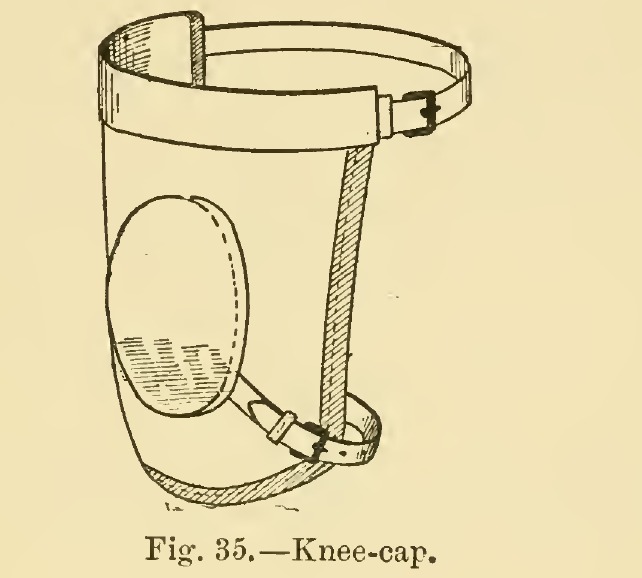


Horse Knee-Cap: Cupped Leather Block, Cloth Shield and Flock-Stuffed Chamois Roll (Hasluck, Saddlery, 1904)
A knee-cap protects a horse's knee from knocks and falls. This one is from Paul N. Hasluck's Saddlery (1904): a leather block beaten into a cup, set on a cloth or leather shield, a flock-stuffed chamois roll along the top strap, and a strap below the knee. Every size is his.
He notes it is often better to buy the pads, but shows how to make them.
Àárín
About 1 day
Ìlànà
1
1
Cutting list
Cutting list
Ń ṣí ìwé Jupyter…
2
2
Read Saddlery, ch. X
Read Saddlery, ch. X
"Knee-caps are of felt, fawn rugging, kersey cloth, union, buff leather, black rubber, etc."
3
3
Beat the knee block
Beat the knee block
With no press, damp some half-curried leather and beat it, as a shoemaker beats boot soles, until it takes a hollow cup shape. Let it dry, then cut it to a wide oval about 5 in by 4 in.
Àwọn ohun èlò fún ìgbésẹ̀ yìí:
 Awọ tí a fi ewéko ṣe1 ẹyọ
 Omi tútù1 ẹyọ
Àwọn irinṣẹ́ tí a nílò:
 Òòlù
 Irin itan
 Ọ̀bẹ awọ
4
4
Cut and bind the shield
Cut and bind the shield
Make the cloth, kersey or leather about 8 in at the top and 9 in deep, and round the bottom. Bind all of it except the straight top with patent binding or cloth; buff leather need not be bound.
Àwọn ohun èlò fún ìgbésẹ̀ yìí:
 Àwo aṣọ irun àgùtàn1 ẹyọ
 Ìlà ìdè etí1 ẹyọ
 Òwú ọ̀gbọ̀1 ẹyọ
 Ìdí Oyin1 ẹyọ
Àwọn irinṣẹ́ tí a nílò:
 Ìṣẹ́ná
 Okùn Ìdíwọ̀n
 Ọ̀kọ̀ Ìlùhò
 Abẹ́rẹ́ ìránṣọ awọ méjì
5
5
Fit the block
Fit the block
Put the leather block on the centre with a piece of shaped cardboard under it, paste the two together and press the cloth down into the hollow. Stitch the block to the cloth about 1-1/4 in from the top and 1-1/2 in from the bottom.
Àwọn ohun èlò fún ìgbésẹ̀ yìí:
 Pátákó bébà lílẹ̀1 ẹyọ
 Ìdí ìyẹ̀fun àlìkámà1 ẹyọÒwú ọ̀gbọ̀1 ẹyọÌdí Oyin1 ẹyọ
Àwọn irinṣẹ́ tí a nílò:
Ọ̀bẹ awọỌ̀kọ̀ ÌlùhòAbẹ́rẹ́ ìránṣọ awọ méjì6
6
Make the top strap
Make the top strap
Cut a piece of leather 1-1/8 in wide and 1 in longer at each end than the cloth at the top. Make a hole at each end 1 in from the point for a 5/8 in strap. Put a chape, buckle and loop in the hole at one end and a 5/8 in strap 9 in long in the other, and stitch both firmly.
Àwọn ohun èlò fún ìgbésẹ̀ yìí:
 Awọ ohun èlò ẹṣin1 ẹyọ
 Buckle idẹ pẹ̀lú ahọ́n1 ẹyọÒwú ọ̀gbọ̀1 ẹyọÌdí Oyin1 ẹyọ
Àwọn irinṣẹ́ tí a nílò:
Ọ̀bẹ awọ Ohun èlò ìlu ihò awọỌ̀kọ̀ ÌlùhòAbẹ́rẹ́ ìránṣọ awọ méjì
7
7
Make the padded roll
Make the padded roll
Cut chamois the same length and width as the strap. With it hanging down in front of the knee-cap and the three edges together, stitch it all along through the top leather and the cloth. Turn the chamois over the top towards the bottom and stitch it along the bottom side of the top strap, rather slack. Make two rows of stitches across the centre, leaving an opening of about 1-1/2 in exactly in the centre. Stuff both parts of the roll from each end with flock, then close the ends by stitching chamois and top leather together.
Àwọn ohun èlò fún ìgbésẹ̀ yìí:
 Awọ rírọ̀ fún ìnu nǹkan1 ẹyọ
 Irun àgùntàn ìkún1 ẹyọÒwú ọ̀gbọ̀1 ẹyọÌdí Oyin1 ẹyọ
Àwọn irinṣẹ́ tí a nílò:
Ìṣẹ́náỌ̀kọ̀ ÌlùhòAbẹ́rẹ́ ìránṣọ awọ méjì8
8
Fit the bottom strap
Fit the bottom strap
Put a 5/8 in chape buckle and loop at the bottom of the block pad, slanting slightly downwards, with a strap 10 in long on the opposite side. For a pair, reverse the buckles so each is on the outside.
Àwọn ohun èlò fún ìgbésẹ̀ yìí:
Awọ ohun èlò ẹṣin1 ẹyọBuckle idẹ pẹ̀lú ahọ́n1 ẹyọÒwú ọ̀gbọ̀1 ẹyọÌdí Oyin1 ẹyọÀwọn irinṣẹ́ tí a nílò:
Ọ̀bẹ awọỌ̀kọ̀ ÌlùhòAbẹ́rẹ́ ìránṣọ awọ méjì9
9
Troubleshooting
Troubleshooting
Knee-cap troubleshooting.
Flow
Loading...
10
10
History and honest limits
History and honest limits
From **Saddlery**, edited by Paul N. Hasluck, David McKay, 1904 (archive.org saddlery00hasl), chapter X, "Knee-caps and Miscellaneous Articles", pp. 81-84, Figs. 33-35; every fraction was read on the scan. He also suggests a better block cut with a tongue up under the top strap, and a fastening with two squares and a 5/8 in rubber ring; those are not shown here. The thread, the tools and the metric figures are ours.
Àwọn ohun-èlò
12- 1 ẹyọÀyè
- 1 ẹyọÀyè
- 1 ẹyọÀyè
- 1 ẹyọÀyè
- 5 ẹyọÀyè
- 5 ẹyọÀyè
- 1 ẹyọÀyè
- 1 ẹyọÀyè
- 2 ẹyọÀyè
- Àyè
- Àyè
- 1 ẹyọÀyè
Ìtọ́nisọ́nà yìí ń ṣe
Blueprint tó jọra
Àwọn blueprint wọ̀nyí pín ìmọ̀ — ọ̀nà, ohun-èlò tàbí ìlànà
CC0 Àgbègbè Gbogbogbò
Blueprint yìí ti jáde lábẹ́ CC0. O lè ṣe àdàkọ, yí padà, pín, àti lò láìsí ìyọ̀ǹda.
Ṣàtìlẹ́yìn Olùṣẹ́dá nípa rírà àwọn ọjà nipasẹ̀ Blueprint wọn Ẹ̀san Olùṣẹ́dá tí àwọn Olùtajà gbé kalẹ̀, tàbí ṣẹ̀dá àtúnṣe tuntun ti Blueprint yìí kí o sì fi sínú Blueprint rẹ gẹ́gẹ́ bí ìsopọ̀ láti pín owó-wíwọlé.