ART
BEAUTY & WELLNESS
CRAFT
CULTURE & HISTORY
ENTERTAINMENT
ENVIRONMENT
FOOD & DRINKS
REVERSE ENGINEERING
SCIENCES
SPORTS
TECHNOLOGY
WEARABLES
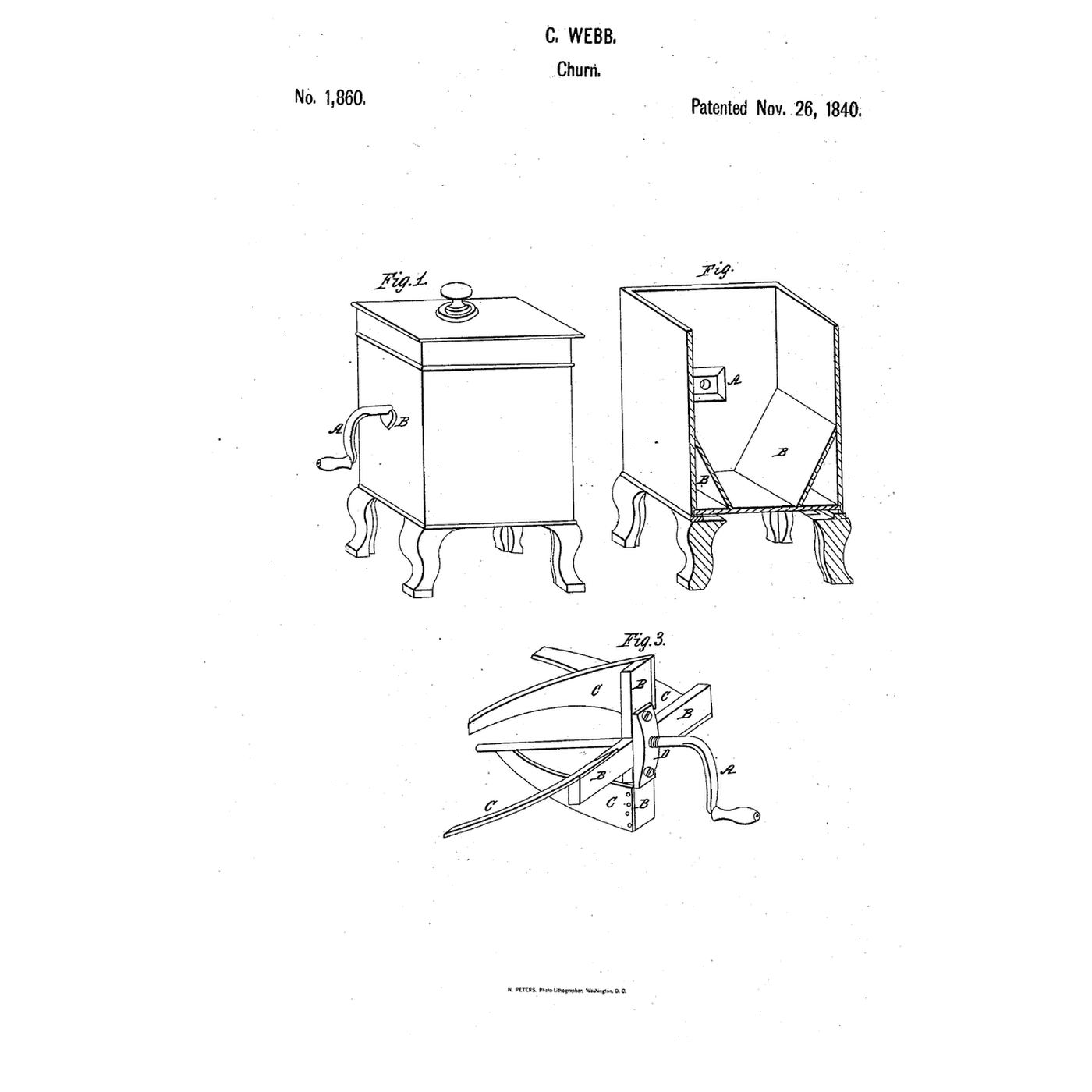

Oblique-Wing Reel Churn: Four Wings Across the Line of the Axle
Webb set out "to agitate the liquid mass, more universally, more expeditiously, and with greater facility and less labor, than by any churn heretofore used."
Constant Webb of Wallingford, Connecticut, received US 1,860, dated 26 November 1840, for "Webb's Economical Churn": a box about twelve inches square and fourteen deep with an iron arbor turned by a crank. On it a cross carries, on each arm, "an agitating wing, made fast to the arm at one end, and passing obliquely to the left across the line of the axle" at about 30°. Slanting boards cut off the bottom corners, and the reel comes off the arbor by reversing its screw so the churn can be scalded clean.
This rung works out the wings' reach, then prints the reel and bearings, fits them to a box, and makes butter.
Intermediate
About 4 hours, plus printing
Instructions
1
1
Wing reach and chamber size
Wing reach and chamber size
Loading Jupyter Notebook...
2
2
A crank-turned reel in a box before it
A crank-turned reel in a box before it
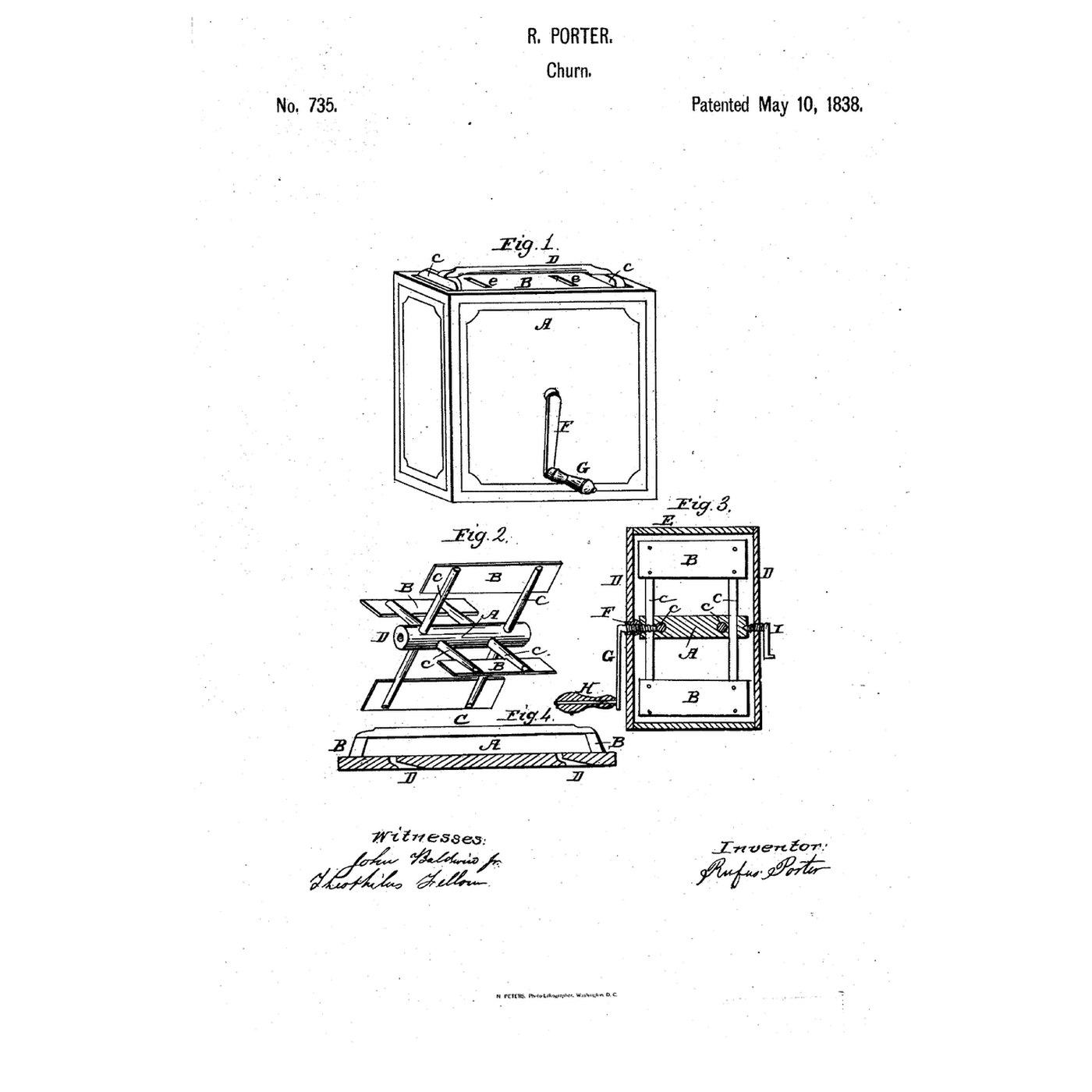
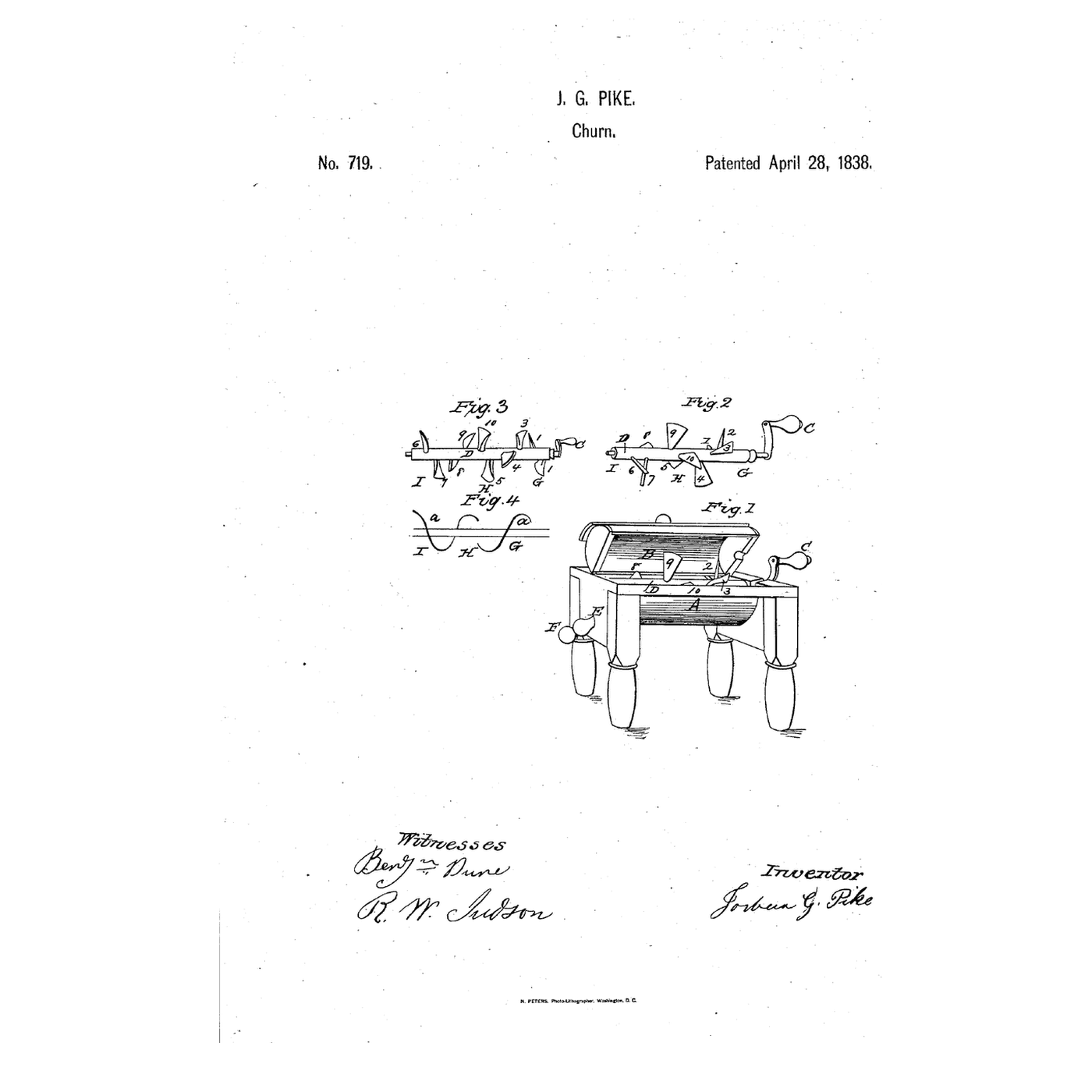
The embedded blueprint carries float boards parallel to the shaft on crossed arms. Webb sets his wings across the line of the axle at about 30°.
3
3
Read US 1,860
Read US 1,860
"The angles at the bottom of the chamber opposite to the edges of the agitating wings are cut off by a slanting board on each side, inclining from the bottom to the side at an angle of about 40 or 45 degrees, nicely fitted and made water tight, giving the same play for the wings as they have from the bottom and sides."
4
4
Print the reel and bearings
Print the reel and bearings
Print the reel standing on its cross (/uploads/blueprints/oblique-wing-reel-churn-reel.stl): the wings rise at 30° to the axis and print without supports. Print the front bearing with its drip lip (/uploads/blueprints/oblique-wing-reel-churn-front-bearing.stl), the rear socket (/uploads/blueprints/oblique-wing-reel-churn-rear-socket.stl) and the crank arm (/uploads/blueprints/oblique-wing-reel-churn-crank-arm.stl). Print in PLA at 0.2 mm layers, 30 % infill, 4 walls; wash before first use.
Materials for this step:
 PLA Filament1 piece
Tools needed:
 FDM 3D Printer
5
5
Fit the box
Fit the box
Take a food-safe box about 150 mm square. Drill the front and back on one line 80 mm up, a little below the centre as he set it. Screw the front bearing over the front hole, lip downward, and the rear socket inside the back. Glue two plywood strips into the bottom corners at 45° and seal them with silicone.
Materials for this step:
 Food-Grade Storage Container1 piece
 Plywood Sheet1 piece
 Silicone Sealant1 piece
 #8 x 1" Wood Screw1 piece
Tools needed:
 Cordless Drill
 Drill Bit Set
 Coping Saw
 Screwdriver Set
6
6
Arbor and reel
Arbor and reel
Hold the reel inside the box and pass a 12 mm hardwood dowel arbor through the bearing and the reel into the socket. Fix the reel with a small screw through its hub, which comes out again for washing. Glue the crank arm on the arbor's front end and a dowel handle in it. Stand the box on legs at a height for turning.
Materials for this step:
 Hardwood Dowels1 piece#8 x 1" Wood Screw1 piece
 Wood Glue1 piece
 Hardwood Block1 piece
Tools needed:
 Hand SawCordless DrillScrewdriver Set
 Sandpaper
7
7
The build in 3D
The build in 3D
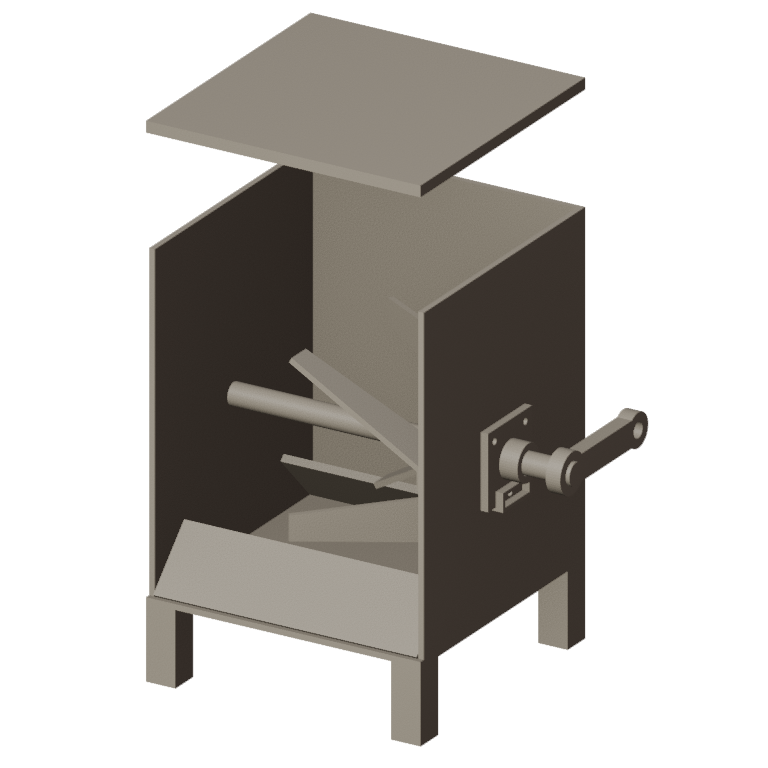
FreeCAD model of this build, not of the patent: the box with one side off and its lid raised, the reel of four oblique wings on the arbor, the slanting boards in the bottom corners, the front bearing with its lip and the crank.
8
8
Crank and make butter
Crank and make butter
Let the heavy cream stand until it reaches about 15 °C, checked with the thermometer. Pour in 500 ml and fit the lid. Turn the crank steadily and time until the butter comes. Pour off the buttermilk, add cold water, churn a little and pour off again until it runs clear; work in a pinch of salt and weigh the butter. Take out the screw and draw the arbor to lift out the reel, and scald the box clean.
Materials for this step:
 Heavy Cream500 ml
 Coarse Sea Salt1 piece
 Water1 piece
Tools needed:
 Leave-In Probe Thermometer
 Stopwatch
 Digital Kitchen Scale
 Stainless Steel Mixing Bowl (Large)
9
9
Wings that scrape, a front that drips
Wings that scrape, a front that drips
Oblique-wing reel churn troubleshooting.
Flow
Loading...
10
10
History and honest limits
History and honest limits
**Constant Webb** of Wallingford, New Haven County, Connecticut, received US 1,860, dated 26 November 1840. His arms reached about six inches from the centre; the arbor's outer end ran in a metal socket in the front with a lip below "to catch and return the oozing if any should flow"; the wings were curved to approach but not touch the sides and bottom. "For larger dairies the several parts may be proportionally increased." He claimed the reel and the manner in which the agitating wing-boards are arranged upon the arms of the cross.
**Honest limits.** A food-safe box and a printed reel with straight wings stand in for his box and curved boards; a screw through the hub stands in for his threaded arbor. FDM prints hold food in their layer lines, so wash well and replace when worn. Your times and weights are the result.
Materials
11- 1 piecePlaceholder
- 1 piecePlaceholder
- 1 piecePlaceholder
- 1 piecePlaceholder
- 2 piecesPlaceholder
- 1 piecePlaceholder
- 1 piecePlaceholder
- 1 piecePlaceholder
- 500 mlPlaceholder
- 1 piecePlaceholder
- 1 piecePlaceholder
Tools Required
11- Placeholder
- 1 vendor sell this, none ship to you yetPlaceholder
- Placeholder
- Placeholder
- Placeholder
- Placeholder
- Placeholder
- Placeholder
- Placeholder
- Placeholder
- Placeholder
Design Files
1Related Blueprints
These blueprints share knowledge with this one — techniques, materials, or principles that connect them in the learning graph.


CC0 Public Domain
This blueprint is released under CC0. You are free to copy, modify, distribute, and use this work for any purpose, without asking permission.
Support the Maker by purchasing products through their Blueprint where they earn a Maker Commission set by Vendors, or create a new iteration of this Blueprint and include it as a connection in your own Blueprint to share revenue.