NGHỆ THUẬT
LÀM ĐẸP VÀ SỨC KHỎE
THỦ CÔNG
VĂN HÓA VÀ LỊCH SỬ
GIẢI TRÍ
MÔI TRƯỜNG
THỰC PHẨM VÀ ĐỒ UỐNG
KỸ THUẬT NGƯỢC
KHOA HỌC
THỂ THAO
CÔNG NGHỆ
THIẾT BỊ ĐEO


Tracking a Belt That Wants to Wander
Abrasive on a stick removes material where you push it. Abrasive on a moving belt removes it everywhere the belt touches, hundreds of times a second, and the tool supplies its own feed.
That changes the problem completely. A hand-sanded surface is limited by your patience; a belt sanded one is limited by how long you dare leave the belt in one place. And a belt on two drums will not stay where you put it unless the axes are parallel.
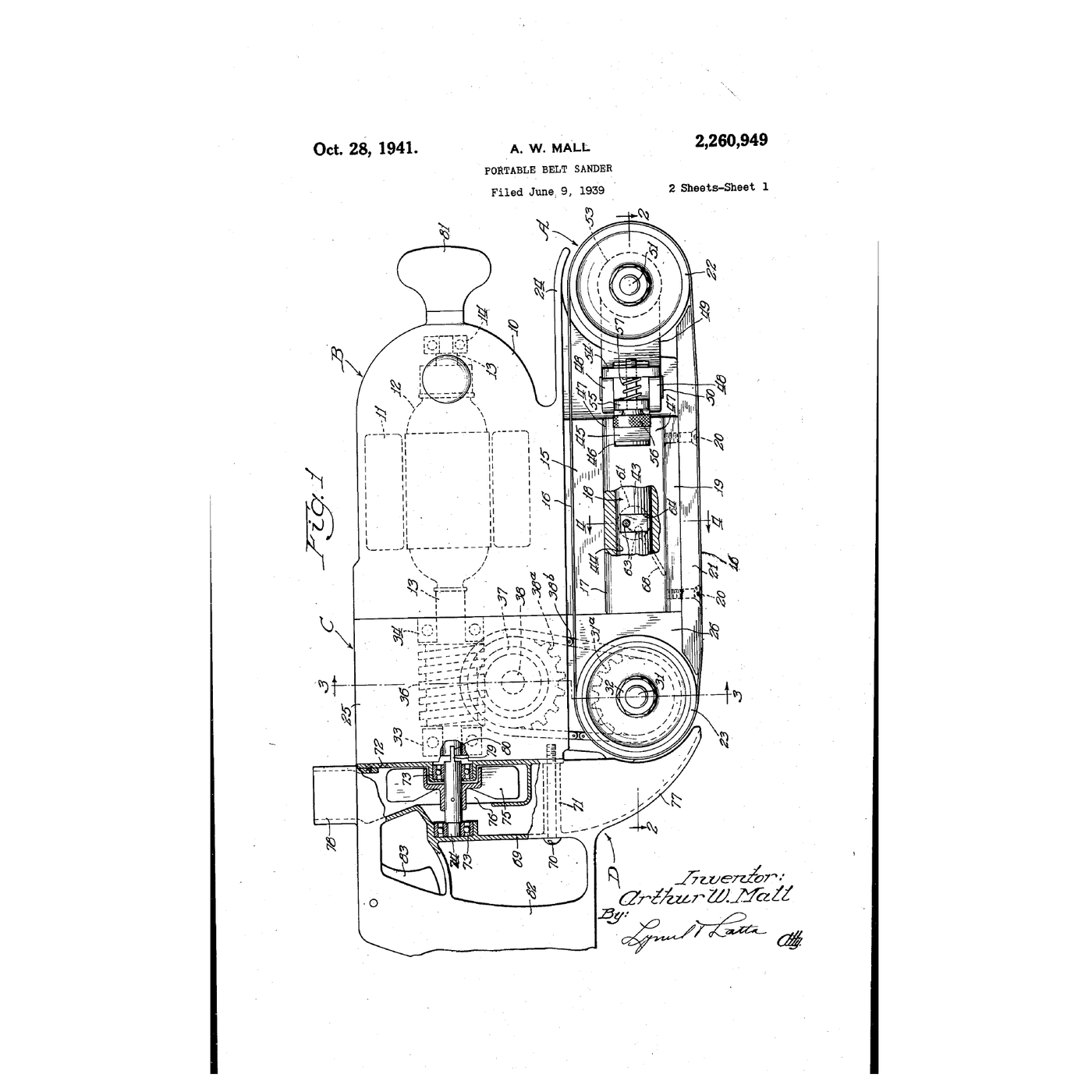
Mall's 1939 patent is about exactly those two things: a tracking adjustment that moves the roller AXIS rather than fighting the belt, and a dust extraction unit built into the tool rather than bolted on afterwards.
Cơ bản
About 90 minutes
Hướng dẫn
1
1
Track the belt by moving an axis, not by pushing the belt
Track the belt by moving an axis, not by pushing the belt
Unplug the sander and fit a belt, noting the arrow printed inside it — most belts have a lapped joint that must trail, not lead, or it peels.
Find the tracking knob. On Mall's design an **adjusting screw 58** passes through ears on the carriage head and swings the front roller so its axis comes parallel with the rear roller's. The patent is specific about why this arrangement and not another: it is set up so 'the pull of the belt will be balanced on either side of the pivot', which means the adjustment does not fight the belt tension while you make it.
Roll the belt by hand — power still off — and watch which way it walks. Adjust, roll again. Only when it stays put by hand should you run it, briefly, off the work.
Step 4 shows why this matters so much: half a degree of axis error walks the belt off the drum in about a second at working speed. Tracking is not something you correct as you go.
Vật liệu cho bước này:
 Bộ đai nhám1 cái
Công cụ cần thiết:
 Máy chà nhám băng
 Bộ tua vít
2
2
Quick release, and the suction unit that is part of the machine
Quick release, and the suction unit that is part of the machine
Mall's patent claims six things and two of them are about servicing the tool rather than using it.
**The belt change.** A roller carriage lets the front roller retract to slacken the belt, held by an **eccentric locking device** — turn the lever and the eccentric shifts the roller centre, dropping the tension in one movement. No spanners, no partial dismantling. The carriage is arranged so belt tension can be adjusted 'without opposing movement', which is the same balanced-pivot idea as the tracking.
**The dust.** A detachable suction unit with its own fan, on separate bearings, coupled to the motor. Not an accessory — a claimed part of the machine. Sanding dust is the difference between an abrasive that cuts and one that burnishes: the swarf packs the grit, the belt stops cutting, and the operator pushes harder, which makes heat rather than shavings.
Take the dust bag off and run the tool for thirty seconds on a scrap, then look at the belt under a loupe against a fresh one. The loading is visible. That is what the fan is for.
Công cụ cần thiết:
Máy chà nhám băngBộ tua vít Bộ lục giác
3
3
Sand a test board and find out how fast you must keep moving
Sand a test board and find out how fast you must keep moving
Take a wide pine board and rule pencil lines across the grain every 50 mm — a witness pattern. Sanding is done when the pencil is gone, and not before or after.
Start the sander OFF the work, let it reach speed, then lower it flat and keep it moving. The belt supplies its own feed force, so the tool will pull itself forward; your job is to restrain it, not to push.
Work along the grain. Across the grain a belt sander leaves scratches that no amount of later finishing hides, because each grit particle cuts a groove the depth of the next coarser abrasive.
Now deliberately stop moving for two seconds on a scrap piece and look at the result: a hollow you can feel with your fingertips and, on a resinous softwood, a burn. Step 4 puts a number on the dwell time that does it.
Finish by measuring the board's thickness at both ends with the caliper. A belt sander removes stock faster at the edges and the ends than in the middle, because the platen overhangs — which is why it is a stock-removal tool, not a flattening tool.
Vật liệu cho bước này:
 Ván thông1 cáiBộ đai nhám1 cái
Công cụ cần thiết:
Máy chà nhám băng Thước cặp điện tử 6 inch
 Kính bảo hộ
 Khẩu trang chống bụi
 Bảo vệ thính giác
4
4
How fast a belt walks off, and how fast it burns
How fast a belt walks off, and how fast it burns
Đang tải sổ tay Jupyter…
Công cụ cần thiết:
Thước cặp điện tử 6 inch5
5
History and context
History and context
**US 2,260,949**, Arthur William Mall. Filed 9 June 1939, granted 28 October 1941, on two sheets. Long expired.
Mall ran the Mall Tool Company of Chicago, a firm that built portable powered tools for trades that could not bring the work to a machine — and which, in the same decade, was also building one of the early one-man chain saws. The same problem, twice: put the motor in the operator's hands and deal with what that costs. Rung 10 of this batch is the other half of that story.
The belt sander's place in the shop is narrower than its power suggests. It removes stock faster than any other hand-held tool and it is the wrong tool for a finished surface — the orbital and random-orbit sanders that arrived later took that job precisely because they do NOT supply their own feed.
**Honest limits.** It scoops hollows if you stop, as step 4 measures. It rounds edges and ends because the platen overhangs. It is loud enough to need protection and dusty enough to need extraction, which is why the extraction was claimed as part of the machine and not left to the user. And a belt tracked by feel rather than by adjustment will come off — usually at the worst moment, which is the one where you are leaning on it.
Công cụ yêu cầu
7- 1 vendor sell this, none ship to you yetTạm thời
- Tạm thời
- Tạm thời
- Tạm thời
- Tạm thời
- Tạm thời
- Bảo vệ thính giácHoa hồng 10%Tạm thời
Blueprint liên quan
Các blueprint này chia sẻ kiến thức — kỹ thuật, vật liệu hoặc nguyên tắc

CC0 Phạm vi công cộng
Bản thiết kế này được phát hành theo CC0. Bạn tự do sao chép, sửa đổi, phân phối và sử dụng cho bất kỳ mục đích nào mà không cần xin phép.
Hỗ trợ nhà sáng tạo bằng cách mua sản phẩm qua bản thiết kế, nơi họ nhận Hoa hồng nhà sáng tạo do nhà bán hàng đặt, hoặc tạo phiên bản mới và kết nối trong bản thiết kế riêng để chia sẻ doanh thu.