NGHỆ THUẬT
LÀM ĐẸP VÀ SỨC KHỎE
THỦ CÔNG
VĂN HÓA VÀ LỊCH SỬ
GIẢI TRÍ
MÔI TRƯỜNG
THỰC PHẨM VÀ ĐỒ UỐNG
KỸ THUẬT NGƯỢC
KHOA HỌC
THỂ THAO
CÔNG NGHỆ
THIẾT BỊ ĐEO

The Wankel Engine: A Three-Cornered Rotor in an Epitrochoid
Felix Wankel wanted an engine with no reciprocating parts. His rotary engine, developed with NSU in Germany in the 1950s, has a three-cornered rotor turning inside a housing shaped like a fat figure-of-eight — an epitrochoid. The rotor's corners stay in contact with the housing all the way round, dividing it into three chambers that each take in, compress, fire and exhaust in turn. There are no valves and no connecting rods; the rotor drives an eccentric shaft directly.
It is smooth and compact for its power. It also has a long, thin combustion chamber and sliding seals at the rotor tips that proved hard to make durable.
This rung generates the housing and the chamber areas, and prints a working model with its 3:2 phasing gears.
Nâng cao
About 8 hours
Hướng dẫn
1
1
Read the 1958 application
Read the 1958 application
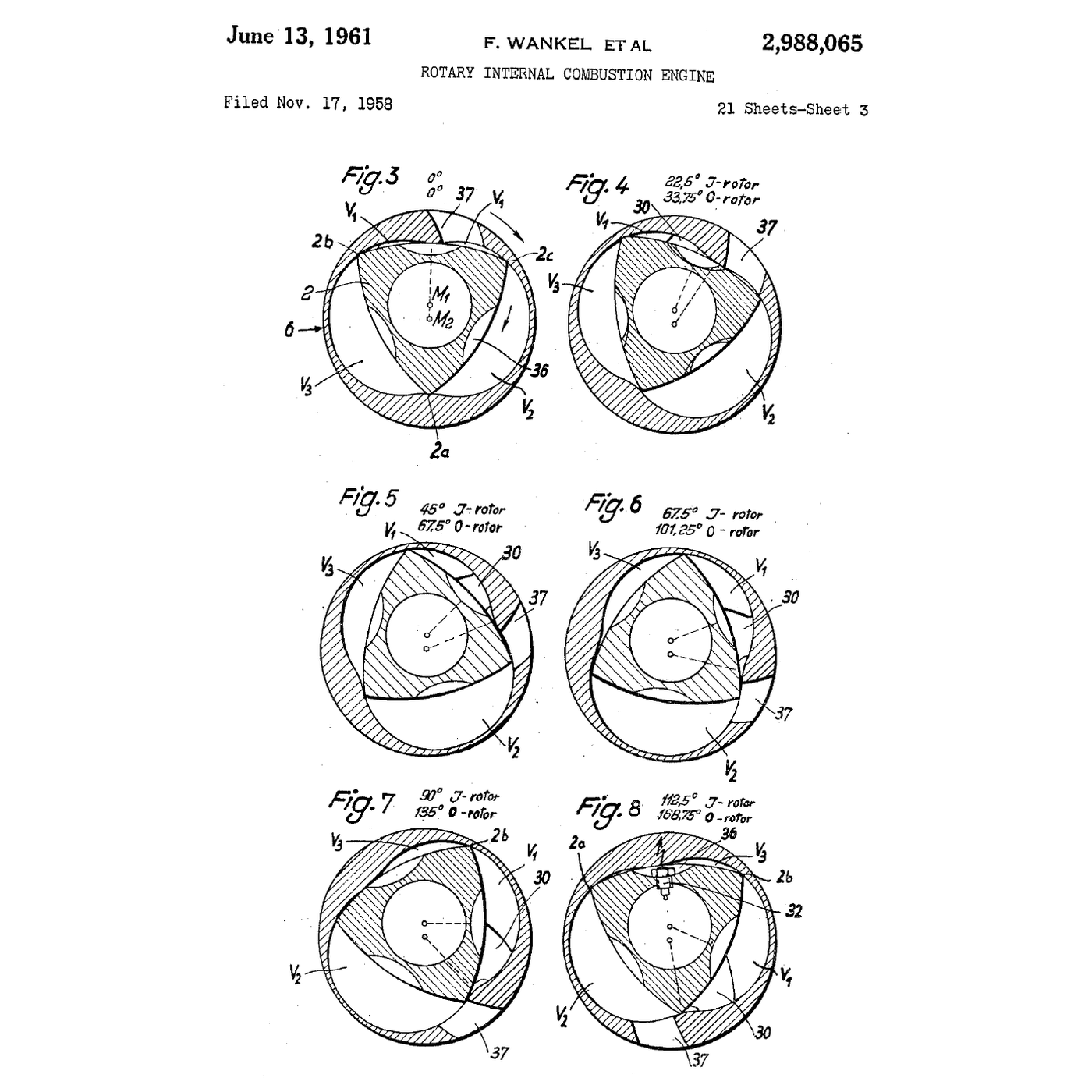
US 2,988,065, 'Rotary Internal Combustion Engine', Felix Wankel and Ernst Hoeppner of Lindau, assignors to NSU Motorenwerke and Wankel GmbH; 38 claims. The specification describes an outer body whose cavity is *"a two-lobed epitrochoid"* and an inner body with *"three apex portions"*, the inner body's outline lying inside the *"inner envelope"* of the epitrochoid — the largest rotor that can turn without hitting the wall. It covers both arrangements: both bodies rotating, or *"the kinematic inversion whereby the outer body is stationary and the inner body performs a planetary rotary movement"* — the form that went into production.
The drawing sheet shown with this blueprint is the first form: both bodies turn. Its figures step through the cycle with paired angles — 22.5° of the inner rotor against 33.75° of the outer, 45° against 67.5°, 90° against 135° — the inner turning two-thirds as fast as the outer, while the chambers V1, V2, V3 grow and shrink between them.
2
2
Generate the housing and the chambers
Generate the housing and the chambers
Đang tải sổ tay Jupyter…
3
3
Print a working model
Print a working model
Use the notebook's R = 100 mm and e = 15 mm, scaled down by half. Export the epitrochoid points to CAD and make a housing plate with that cavity, 20 mm deep, and a clear acrylic cover.
The rotor is a triangle with its sides bowed outward, apexes at the generating radius; give it clearance so it does not bind on the curved flanks. On its face print an **internal gear of 30 teeth**; on the housing, round the shaft, a fixed **external gear of 20 teeth**. That 3:2 ratio makes the rotor turn once for every three turns of the shaft. The rotor rides on an eccentric of 7.5 mm throw on the shaft.
Turn the shaft by hand and watch each chamber grow and shrink. Mark one chamber and count: three shaft turns for its full cycle.
Vật liệu cho bước này:
 Sợi in PETG150 g
 Tấm acrylic1 tờ
 Thép thanh thô1 cái
 Vòng bi ván trượt2 cái
 Vít máy8 cái
Công cụ cần thiết:
 Máy in 3D sợi nhựa (FDM)
 Thước cặp điện tử 6 inch
 Bộ lục giác
 Máy khoan pin
 Bộ mũi khoan
4
4
History and context
History and context
**US 2,988,065, 'Rotary Internal Combustion Engine', Felix Wankel and Ernst Hoeppner; filed 17 November 1958 (Serial 774,517), claiming Austrian priority of 11 March 1958; granted 13 June 1961.** NSU's first running engine dates from 1957; NSU and then Mazda built Wankel-engined cars, Mazda for decades.
**Honest limits.** The apex seals must slide against the housing at high speed and were the engine's weak point for years. The long, thin combustion chamber has a lot of cold wall per unit of volume, which hurts fuel economy and emissions. And one power stroke per shaft turn per rotor makes it smooth, but it needs high shaft speeds.
Vật liệu
5- 150 gTạm thời
- 1 tờTạm thời
- 1 cáiTạm thời
- Vòng bi ván trượtHoa hồng 10%2 cáiTạm thời
- 8 cáiTạm thời
Công cụ yêu cầu
5- Tạm thời
- Tạm thời
- Tạm thời
- 1 vendor sell this, none ship to you yetTạm thời
- Tạm thời
Blueprint liên quan
Các blueprint này chia sẻ kiến thức — kỹ thuật, vật liệu hoặc nguyên tắc
Otto Four-Stroke Engine
bởi Martin
Vật lý học
46
0
0
0
0
0
The Crank and the Flywheel: Smoothing One Bang in Two Turns
bởi Martin
Cơ học
15
0
0
0
0
0
The Magneto and the Spark Plug: Thousands of Volts at the Right Moment
bởi Volt
Cơ học
7
0
0
0
0
0
Cams and Valve Timing: Open Early, Close Late
bởi Martin
Cơ học
6
0
0
0
0
0
The Scroll Compressor: Two Spirals, One Orbiting, No Valves
bởi Emma
Cơ học
10
0
0
0
0
0
Roots Blower
bởi Karen
Cơ học
39
0
0
0
0
0
The Involute: Why Gear Teeth Are That Shape and No Other
bởi Martin
Cơ học
28
0
0
0
0
0
CC0 Phạm vi công cộng
Bản thiết kế này được phát hành theo CC0. Bạn tự do sao chép, sửa đổi, phân phối và sử dụng cho bất kỳ mục đích nào mà không cần xin phép.
Hỗ trợ nhà sáng tạo bằng cách mua sản phẩm qua bản thiết kế, nơi họ nhận Hoa hồng nhà sáng tạo do nhà bán hàng đặt, hoặc tạo phiên bản mới và kết nối trong bản thiết kế riêng để chia sẻ doanh thu.